
Most people buy the wrong thermal labels. Not because they chose the wrong size. Because they chose the right size with the wrong core, the wrong material, or the wrong adhesive for their printer. The label does not fit. Or it fits but does not print. Or it prints but peels off in the freezer.
This guide fixes that. We cover every label size, every material, every core size, and exactly which printers each one works with. Start at the section that matches your problem.
Every Common Thermal Label Size and What It Does
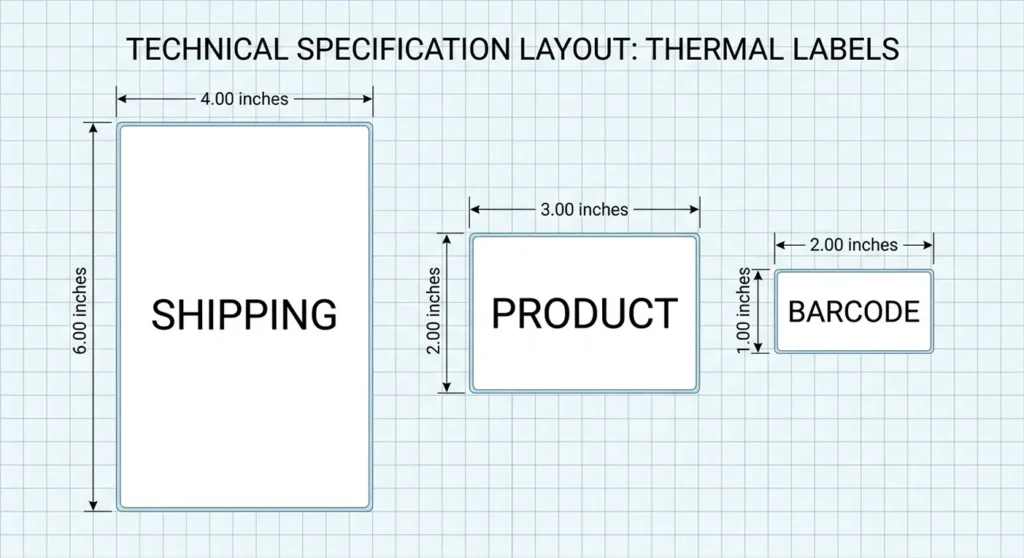
The size is the first decision. Here is the complete reference before we go deeper.
| Label Size | Format | Primary Use | Printer Width Required |
|---|---|---|---|
| 4×6 inch | Roll or fan-fold | Shipping labels: USPS, UPS, FedEx, DHL, Amazon FBA | 4-inch printer |
| 3×2 inch | Roll | Product labels, price tags, warehouse bin labels | 4-inch printer |
| 2×1 inch | Roll | Barcode labels, SKU labels, small product ID | 2-inch or 4-inch printer |
| 3×1 inch | Roll | Address labels, mailing labels | 4-inch printer |
| 2.25×1.25 inch | Roll | DYMO-format UPC and SKU labels | 2-inch printer |
| 2×2 inch | Roll | QR codes, round product seals | 2-inch or 4-inch printer |
| 4×2 inch | Roll | Food container labels, product info labels | 4-inch printer |
| Fan-fold 4×6 | Stacked | High-volume warehouse auto-feed printing | 4-inch printer |
What Is the Standard Thermal Label Size?
4×6 inches is the standard and every major carrier accepts it. USPS, UPS, FedEx, and DHL all require the 4×6 format for domestic and international parcel labels. Every major shipping platform — Shopify, Etsy, Amazon Seller Central, eBay, Pirate Ship, and ShipStation — generates 4×6 PDFs by default.
If you are shipping parcels, 4×6 is the only size you need to think about. Every other size on that table is for something other than a shipping label.
What Label Size Do Barcode Labels Use?
2×1 is the standard for barcode labels. At 203 DPI, a 2×1 label holds a Code 128, Code 39, EAN-13, or QR code with a product name or SKU number alongside it. For wider barcodes that carry more data, like GS1-128 or DataMatrix, step up to 3×2. The extra width prevents barcode truncation, which causes scan failures at the carrier’s sort facility.
What About Fan-Fold Labels?
Fan-fold labels are the same 4×6 format, stacked accordion-style instead of wound on a roll. They sit in a stack below or beside the printer and feed up continuously. Warehouses use fan-fold because the stacks hold 500 to 1,000 labels without a roll changeover. Desktop printers take roll format. Industrial printers on a dock station take fan-fold. The label itself is identical. The feeding method differs.
Direct Thermal vs Thermal Transfer Labels: Which One Does Your Printer Need?
This is the mistake we see most often. Someone buys thermal transfer labels for a direct thermal printer. The printer runs the label through and produces nothing. The labels are not defective. They are simply the wrong type.
Here is the one-minute test to confirm which type your printer uses.
The fingernail test: Scratch your fingernail firmly across a blank label loaded in your printer. If the scratched area turns dark or black, the label is direct thermal paper. The heat from friction activates the leuco dye coating. If nothing changes, the label is thermal transfer stock and your printer requires a ribbon.
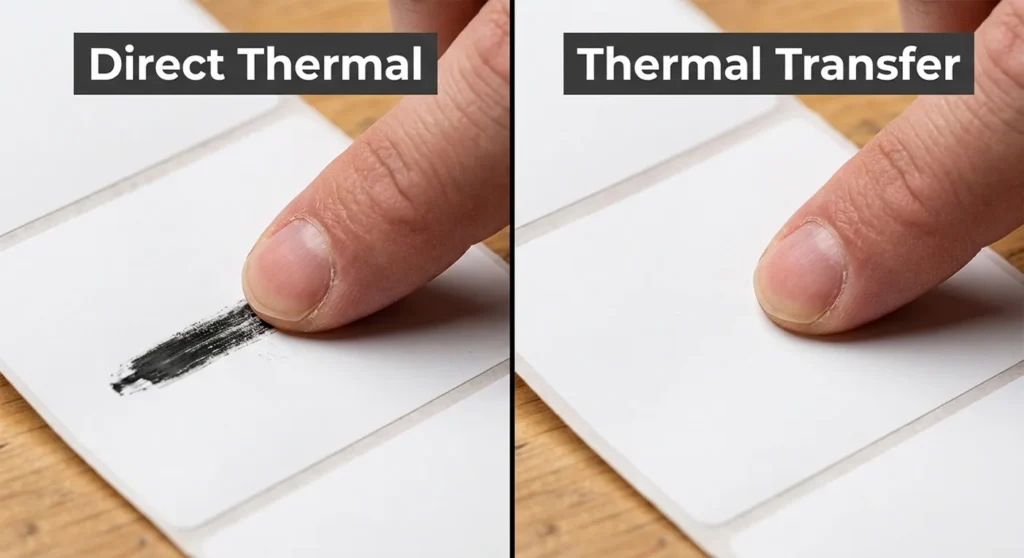
Two backup checks if you prefer:
- If your printer has a ribbon roll installed alongside the label roll, it is a thermal transfer printer.
- If your printer has one media compartment and no ribbon spool, it is a direct thermal printer.
| Printer Type | Ribbon Required | Compatible Label Materials |
|---|---|---|
| Direct thermal | No | Heat-sensitive coated paper only |
| Thermal transfer | Yes (wax, wax-resin, or resin) | Paper, polypropylene, polyester, vinyl, PVC, clear |
The choice between these two methods determines every other label decision you make, including material, adhesive, and lifespan. Before choosing between paper and synthetic label stock, our breakdown of direct thermal vs thermal transfer printing and which method fits your label lifespan requirements covers the full cost and durability comparison with real numbers.
Label Materials: Paper, Polypropylene, Polyester, and Clear
The material determines how long the label lasts, what environments it survives, and which printer it works with. There are four categories. Each has a specific use case and a specific printer compatibility requirement.
Standard Paper Thermal Labels
Paper labels are the cheapest option per unit. Direct thermal paper labels print without a ribbon and cost approximately $0.01 to $0.03 per label at volume. The trade-off is lifespan: 6 to 12 months in ambient conditions before the print fades under heat and UV exposure.
For shipping labels that travel on a parcel and get discarded after delivery, fading in 6 months is irrelevant. Paper direct thermal is the correct choice.
Thermal transfer paper labels use the same paper substrate but require a ribbon. A wax or wax-resin ribbon transfers ink onto the paper surface and the result lasts 1 to 2 years. Warehouse inventory labels, retail price tags, and product identification labels that sit on shelves for months belong on thermal transfer paper, not direct thermal paper.
Synthetic Labels: Polypropylene and Polyester
Both synthetic materials require thermal transfer printing. Direct thermal printers produce no output on synthetic substrates because polypropylene and polyester contain no leuco dye coating. The printhead applies heat and the label passes through unchanged.
Polypropylene (PP) labels resist moisture and light oils. Food containers, cosmetics, and bath products get wet during use. Paper labels soak through and peel. PP labels do not. With a wax-resin ribbon, PP labels last 2 to 5 years in ambient warehouse conditions. Cost per label runs 20 to 40 percent higher than standard paper.
Polyester (PET) labels are the most durable option in the thermal label category. They resist abrasion, UV exposure, chemical contact, and temperatures from -65°F to 300°F when paired with a freezer-grade adhesive and resin ribbon. Asset tags on equipment that stays in service for a decade use polyester. GHS chemical labels on industrial drums use polyester. With a resin ribbon, polyester labels last 10 or more years.
Clear Labels for Thermal Printers: The Misunderstood Category
Direct thermal printers cannot print on clear labels. Full stop.
Clear labels are manufactured from PET, PP, or PVC. None of those materials have thermochromic coating. When a direct thermal printer’s printhead applies heat to a clear label, nothing reacts. The label exits blank.
Thermal transfer printers print on clear labels when paired with a resin ribbon. The resin ink bonds to the transparent substrate and produces black text or barcodes on a clear background. This creates the “no-label look” that cosmetic brands, specialty food labels, and boutique jar labels use to show the product through the packaging.
If you own a Rollo, a DYMO 4XL, a MUNBYN desktop printer, or any other direct thermal printer, clear labels do not work with your machine. The solution is either switching to a thermal transfer printer or sourcing pre-printed clear labels with a white direct thermal overprint area built into the label face.
According to ZYWELL’s technical analysis, clear PET, PP, and PVC labels lack the heat-sensitive coating that direct thermal printing requires, making thermal transfer with a resin ribbon the only compatible method for transparent substrates.
For printing actual color output on clear or standard labels, read our full guide on whether thermal label printers can print in color and what your actual options are.
Core Size and Roll Size: The Spec Nobody Warns You About
This is the detail that most label guides skip entirely. We did not skip it because it is the second most common reason a label order fails.
The core is the cardboard tube at the center of the label roll. Two standard diameters exist. Buying the wrong one means the roll physically does not seat correctly in the printer’s media spindle. Print errors follow immediately.
1-Inch Core vs 3-Inch Core: Which One Fits Your Printer
1-inch core: Desktop printers use 1-inch cores. Rollo, DYMO 4XL, MUNBYN desktop models, Zebra ZD421, Zebra GK420d, JADENS, and HPRT SL42 all use 1-inch core label rolls. The vast majority of label rolls sold on Amazon target this format. If you bought a desktop printer for home or small office shipping, every standard label roll you see on Amazon uses a 1-inch core.
3-inch core: Industrial printers use 3-inch cores. Zebra ZT411, Zebra ZT610, Honeywell PM43, and TSC MX240P all use 3-inch core label rolls. These rolls hold 1,000 to 5,000 labels per roll, compared to 250 to 500 on desktop 1-inch rolls. Fewer changeovers means fewer interruptions on a busy warehouse dock.
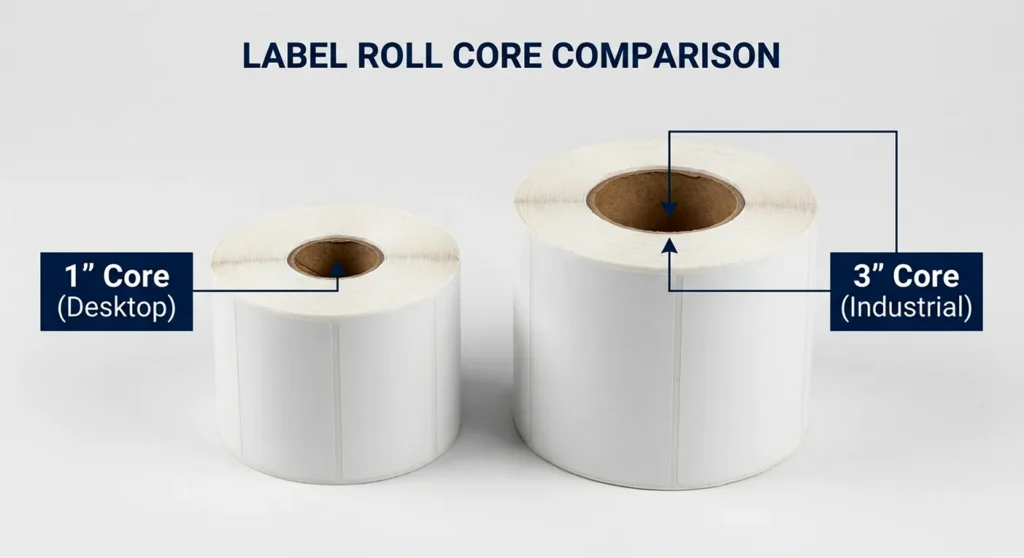
Loading a 3-inch core roll into a 1-inch core desktop printer does not work. The roll sits loose on the spindle. The label path misaligns. The printer feeds incorrectly from the first label.
Label Roll Outer Diameter: How Big a Roll Your Printer Accepts
Outer diameter (OD) is the maximum roll size the printer’s media compartment fits.
Desktop printers accept rolls up to approximately 5 inches OD. Industrial printers accept rolls up to 8 inches OD. Buying an 8-inch OD industrial roll for a desktop printer means the roll does not physically fit inside the printer housing.
| Printer Category | Core Size | Max OD | Labels per Roll (4×6) |
|---|---|---|---|
| Desktop: Rollo, DYMO 4XL, MUNBYN, Zebra ZD421, Zebra GK420d, JADENS | 1-inch | 5-inch | 250 to 500 |
| Industrial: Zebra ZT411, ZT610, Honeywell PM43, TSC MX240P | 3-inch | 8-inch | 1,000 to 5,000 |
According to Label Blanks’ printer compatibility guide, desktop Zebra printers handle labels up to 4.25 inches wide with 1-inch cores, while industrial Zebra models accept up to 6-inch wide labels with 3-inch cores, and using the wrong core size causes loading issues and print errors.
Before choosing between paper and synthetic stock, it also helps to understand the printing mechanism itself. Our guide on how thermal label printers work, including the difference between direct thermal and thermal transfer mechanisms, explains why material compatibility is tied directly to print method.
Adhesive Types: Permanent, Removable, Freezer-Grade
The substrate gets the attention. The adhesive determines whether the label stays on.
Permanent adhesive bonds to corrugated cardboard, poly mailers, and kraft paper without lifting. Standard on the vast majority of 4×6 shipping label rolls. Not designed for removal after application. This is what every Rollo, DYMO, and MUNBYN user has on their printer right now.
Removable adhesive holds firmly but peels off without leaving residue. Retail price tags use removable adhesive so the buyer does not damage the product removing the sticker. Warehouse location labels on equipment that gets relocated use removable adhesive. Removable adhesive does not grip as aggressively as permanent under friction, moisture, or extended time. Do not use it on a shipping label.
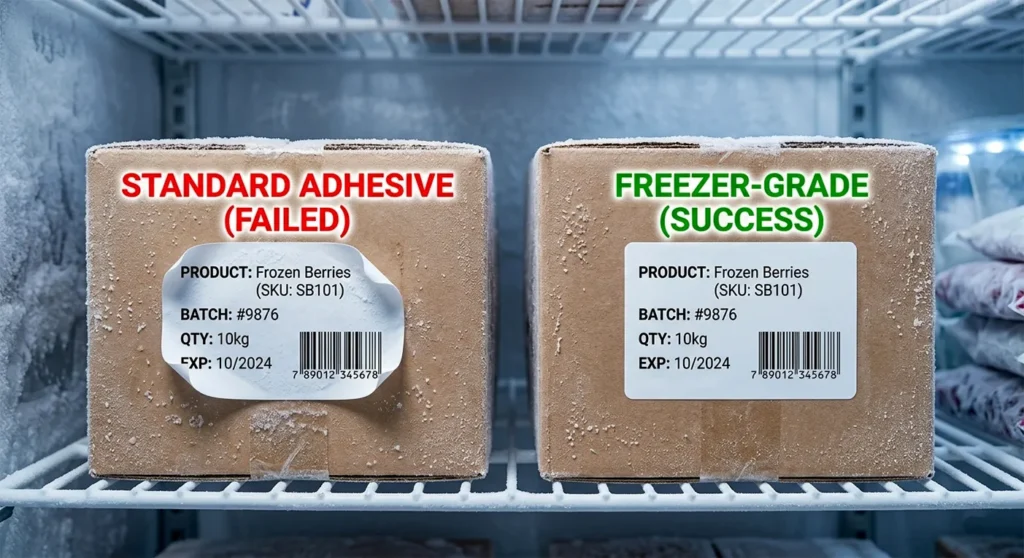
All-temperature adhesive (freezer-grade) maintains bond strength at temperatures down to -65°F. Standard permanent acrylic adhesive loses tack below approximately 20°F and peels off chilled or frozen surfaces. Frozen food labels, pharmaceutical cold storage labels, and cold chain shipping labels require all-temperature adhesive, paired with a PP or PET substrate for the complete waterproof and freeze-resistant combination.
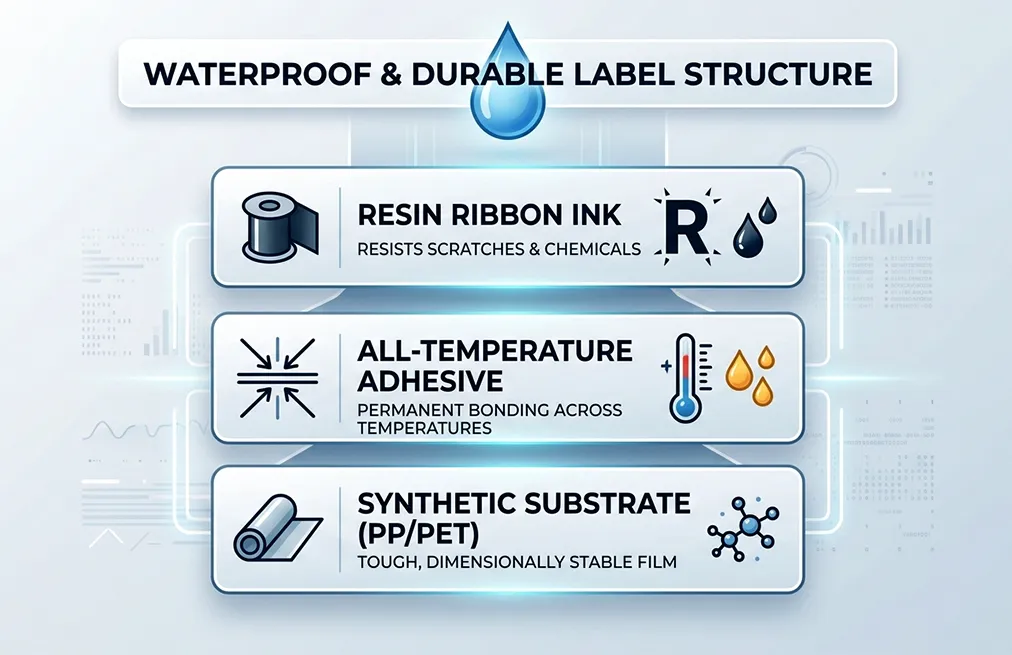
The waterproof label system: A waterproof label requires three elements working together: a synthetic substrate (PP or PET), a permanent all-temperature adhesive, and a resin ribbon (for thermal transfer printing). Getting two out of three correct produces a label that still fails. A PP substrate with a wax ribbon is not waterproof because the wax ink smears and washes off even if the stock does not. All three must be correct.
Colored Thermal Labels and Thermal Label Stickers
Colored thermal labels use dyed paper stock as the background. The thermal printer still prints black marks on top. The color is the paper, not the print.
Yellow, red, blue, green, and orange thermal label stock is available from Barcodefactory and LabelValue in 4×6 and 3×2 formats. Warehouses use colored stock for visual zone coding: yellow labels for receiving, red for returns, green for ready-to-ship. The thermal printer does not change. The label roll changes.
“Thermal label stickers” is the consumer term for what warehouses and businesses call thermal labels. The product is identical: pressure-sensitive adhesive labels on a roll, printed in a direct thermal or thermal transfer printer. Etsy sellers searching for sticker labels and logistics managers searching for label rolls are buying the same product.
Custom Thermal Labels and Label Templates
Custom Labels
Custom thermal labels are die-cut or non-standard-size labels manufactured to specific dimensions. Most custom label suppliers, including LabelValue, Barcodefactory, and Brady Corporation, accept custom size orders with minimum order quantities of 500 to 1,000 rolls and lead times of 3 to 5 business days.
For short-run custom labels with no MOQ requirement, the Brother VC-500W prints full-color custom labels using ZINK thermal technology on CZ and CK rolls in sizes up to 2 inches wide. For 4-inch wide full-color custom labels, an inkjet color label printer such as the Epson ColorWorks CW-C6000 is the correct tool. It is not a thermal printer, but it is the right answer for that specific need.
Label Templates
Thermal printer label templates are pre-designed layout files that match your label size and data requirements. Four sources cover most use cases:
ZebraDesigner is a free Windows application from Zebra. It handles barcode generation, text fields, and logo placement with a drag-and-drop interface. It works with all major thermal brands, not just Zebra.
NiceLabel offers a free Designer Express tier. It supports ZPL, EPL, TSPL, and most other thermal printer command languages. More complex than ZebraDesigner but more flexible for multi-format operations.
Canva allows custom label dimensions in the resize tool. Download as PDF, set your printer to print at 100% scale with no scaling. Label dimensions must match the physical roll exactly. Canva works for logos and custom branding but does not generate scannable barcodes natively.
ShipStation, Pirate Ship, and Shippo generate 4×6 shipping label PDFs automatically from order data. No design required. The template is built into the platform.
Where to Buy Thermal Labels
Amazon
The widest selection of 4×6 direct thermal labels at the lowest per-label cost. BETCKEY, JADENS, and MUNBYN-branded 4×6 rolls deliver 500 labels per roll at approximately $12 to $18. Prime-eligible options arrive next day. BETCKEY and Arkscan manufacture rolls explicitly confirmed as compatible with Rollo, Zebra, and MUNBYN desktop printers. Avoid rolls that do not list core size in the product specs.
Office Depot and Staples
Office Depot stocks Avery-brand thermal labels and a limited selection of 4×6 rolls for same-day pickup. Stock depth is narrower than Amazon for specialty sizes like 2×1 or 3×2. Staples carries DYMO-brand label rolls in-store. Both are the right choice when you need labels today and cannot wait for shipping.
Specialty Suppliers
Barcodefactory, LabelValue, and Arkscan specialize in industrial label rolls with 3-inch cores, 8-inch OD, 1,000-plus labels per roll, specialty materials including polyester and freezer-grade, and bulk pricing with volume discounts. If you operate an industrial Zebra or Honeywell printer, buy from here, not Amazon.
MUNBYN Direct
MUNBYN sells branded label rolls through their website and on Amazon, compatible with MUNBYN printers and all standard 4-inch desktop thermal printers. Fan-fold format is available. Their 4×6 rolls use a 1-inch core and 5-inch maximum OD, confirmed compatible with Rollo and Zebra ZD-series desktop printers.
Which Labels Fit Your Specific Printer
Every printer has a maximum label width, a core size, and a maximum roll OD. Buying labels without checking these three specs wastes money and time. Here is the confirmed spec for every printer we cover.
Rollo: Accepts any 4-inch wide direct thermal label roll with a 1-inch core and maximum 5-inch OD. Standard 4×6 rolls from BETCKEY, MUNBYN, Arkscan, and most Amazon brands fit without calibration.
DYMO 4XL: Designed for DYMO-branded DK rolls. Third-party 4×6 rolls with a 1-inch core fit the media compartment physically. Some firmware versions block non-DYMO rolls at the software level. BETCKEY and Arkscan manufacture DYMO-compatible rolls that work with both firmware versions. Confirm compatibility in the product listing before ordering.
MUNBYN desktop printers: Standard 4-inch wide, 1-inch core rolls fit all current MUNBYN desktop models. MUNBYN printers use gap sensing for label detection and auto-advance.
Zebra GK420d: 1-inch core, maximum 5-inch OD, 4-inch maximum label width. Direct thermal only, no ribbon compartment. Compatible with standard 4×6 rolls from any supplier confirmed for Zebra-compatible printers.
Zebra ZD421: 1-inch core, maximum 5-inch OD, 4-inch maximum label width. Supports both direct thermal and thermal transfer modes. In thermal transfer mode, accepts 2-inch, 3-inch, and 4-inch wide labels for barcode and address label applications. Uses gap or black mark sensing.
Zebra ZT411 (industrial): 3-inch core, maximum 8-inch OD, 4-inch print width. Compatible with paper, polypropylene, and polyester label stock. Synthetic materials require ribbon.
Honeywell PM43 (industrial): 3-inch core, maximum 8-inch OD, 4-inch print width. Compatible with paper, PP, and PET substrates. Supports wax, wax-resin, and resin ribbons.
JADENS Bluetooth printer: 1-inch core, 4-inch maximum width, standard 4×6 shipping label format. Gap sensing only. Compatible with BETCKEY, MUNBYN, and Arkscan 4×6 rolls.
Brother QL-800: Uses proprietary DK die-cut rolls exclusively. Not compatible with standard 4-inch label rolls from any third-party supplier. DK rolls are a Brother-specific format and are not interchangeable with any other brand’s label system.
For operations printing 500 or more labels per day on industrial printers with 3-inch core rolls, our comparison of the best high-volume thermal label printers for warehouse and logistics use covers printer specs, duty cycles, and industrial roll compatibility in detail.
Frequently Asked Questions
What thermal labels work with a Rollo printer?
Any 4-inch wide direct thermal label roll with a 1-inch core and maximum 5-inch outer diameter works with the Rollo. The Rollo accepts rolls from BETCKEY, MUNBYN, Arkscan, JADENS, and most standard Amazon 4×6 label brands. The Rollo does not use proprietary rolls. It accepts any 4-inch wide direct thermal roll.
Can I use any 4×6 labels with a DYMO 4XL?
The DYMO 4XL physically accepts any 4-inch wide, 1-inch core label roll. The software compatibility depends on firmware version. Some DYMO 4XL units running newer firmware reject non-DYMO rolls via software detection. BETCKEY sells DYMO-compatible 4×6 rolls confirmed to work across both firmware versions. Check the product listing for explicit DYMO 4XL compatibility confirmation.
What is the difference between direct thermal and thermal transfer labels?
Direct thermal labels have a heat-sensitive coating that darkens under printhead heat. No ribbon required. They fade in 6 to 12 months. Thermal transfer labels have no heat-sensitive coating and require a ribbon that melts ink onto the label surface. They last 1 to 10-plus years depending on ribbon type and substrate. The fingernail test tells you which type you have: scratch the label surface. Dark mark means direct thermal. No change means thermal transfer.
Can a direct thermal printer use clear labels?
No. Clear labels are manufactured from PET, PP, or PVC, none of which have thermochromic coating. A direct thermal printer’s printhead applies heat and produces no output on clear substrates. Clear label printing requires a thermal transfer printer with a resin ribbon.
What core size do I need for a Zebra ZT411?
The Zebra ZT411 uses a 3-inch core with a maximum 8-inch outer diameter. Desktop Zebra printers including the ZD421 and GK420d use a 1-inch core. Buying 3-inch core rolls for a desktop Zebra or 1-inch core rolls for a ZT411 produces a fitment failure. Confirm core size before ordering from any supplier.
What labels does a Zebra ZD421 use?
The Zebra ZD421 accepts 1-inch core rolls, 4-inch maximum width, 5-inch maximum OD. It runs in direct thermal mode (no ribbon, paper labels only) or thermal transfer mode (ribbon required, accepts paper and synthetic substrates). In thermal transfer mode, it accepts 2-inch through 4-inch wide labels.
Are thermal labels waterproof?
Standard direct thermal paper labels are not waterproof. They soak through, smear, and peel when wet. A waterproof thermal label requires three elements: a synthetic substrate (PP or PET), an all-temperature permanent adhesive, and a resin ribbon (thermal transfer only). All three must be present. A PP label with a wax ribbon is not waterproof because the wax ink washes off.
What thermal labels work at Office Depot?
Office Depot carries Avery-brand thermal labels and a limited selection of 4×6 rolls in-store. Avery 5163 is a sheet-format label confirmed compatible with thermal printers that handle cut-sheet media. For roll-format 4×6 labels, Office Depot stock is limited. Staples carries DYMO DK rolls for DYMO printers in-store. For industrial rolls or specialty materials (polyester, freezer-grade), specialty suppliers like Barcodefactory and LabelValue carry more depth than either retail chain.
The Decision, Plainly
You don’t need to read every section of this guide every time you buy labels. You need to answer four questions and match them to the table.
Question 1: What size? 4×6 for shipping. 2×1 for barcodes. 3×2 for product and price labels. 3×1 for address labels.
Question 2: What printer type? Scratch test. Dark mark means direct thermal paper only. No change means thermal transfer, buy the right ribbon too.
Question 3: What core size? Desktop printer means 1-inch core. Industrial printer means 3-inch core. Check your printer’s manual if you are not certain.
Question 4: What environment? Short-term indoor shipping means standard direct thermal paper. Long-term warehouse means thermal transfer paper with wax-resin ribbon. Freezer or outdoor means synthetic substrate plus all-temperature adhesive plus resin ribbon.
Those four questions determine the correct label. For the right ribbon to pair with synthetic labels, our guide to thermal transfer ribbon types and which ribbon matches your label material breaks down wax, wax-resin, and resin compatibility by substrate with cost-per-label data.
Affiliate Disclosure: We earn commissions from qualifying purchases at no extra cost to you. This supports independent testing and updates to this guide.