
Direct thermal printing uses heat to activate a chemical coating built into the label surface. No ribbon, no ink, no toner. Thermal transfer printing uses heat to melt ink from a separate ribbon onto the label. Direct thermal labels last 6 to 12 months before fading under normal conditions. Thermal transfer labels last 2 to 35 years depending on the ribbon type and label material. For Etsy, Shopify, eBay, and Amazon sellers printing 4×6 shipping labels, direct thermal is the right choice. For product labels, freezer labels, outdoor labels, asset tags, or compliance labels, thermal transfer is the only method that works.
If you already know direct thermal fits your workflow, see our comparison of the best thermal label printers tested on print speed, label cost, and platform compatibility. If you are still deciding which print method you need, keep reading.
What Is the Difference Between Direct Thermal and Thermal Transfer Printing?
The difference comes down to where the printed image originates.
In direct thermal printing, the label material itself contains a heat-sensitive chemical coating. When the printhead runs across it, heat activates the coating and turns specific areas black. The label is the consumable. The printer has no ribbon, no ink, and no moving parts beyond the printhead and the feed mechanism. That simplicity is the whole appeal of direct thermal.
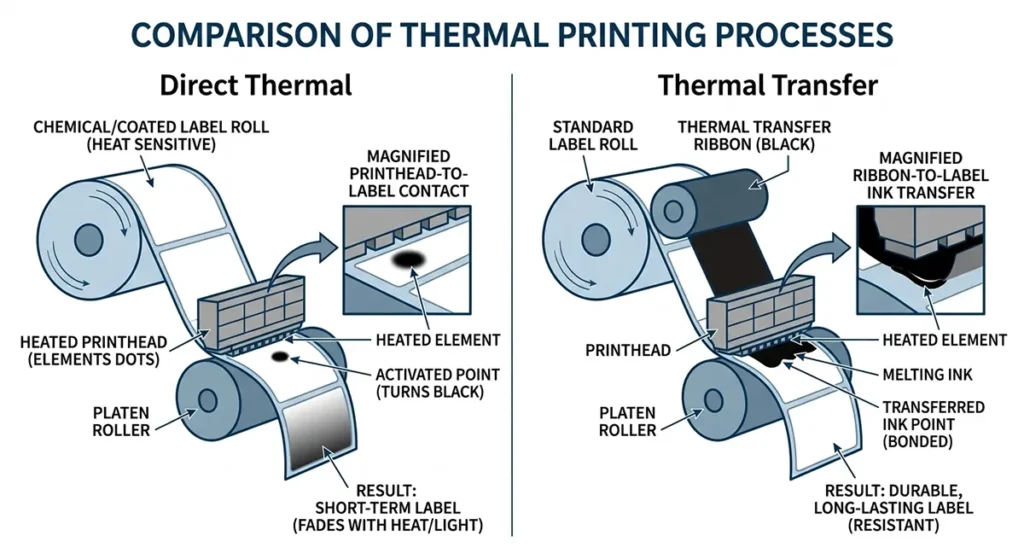
In thermal transfer printing, a ribbon sits between the printhead and the label. Heat melts ink from the ribbon surface and bonds it permanently to the label substrate. The label material can be paper, polypropylene, polyester, or vinyl. Both the label and the ribbon are consumables. The ribbon type determines how durable and chemically resistant the final print is.
That mechanical difference creates a huge durability gap, which dictates which method fits which use case.
How Direct Thermal Printing Works
A direct thermal printer contains one consumable: the label roll. Load the roll, connect the printer, and print. There is no ribbon to thread, no ink level to monitor, and no toner cartridge to replace. The printhead elements heat up, make contact with the chemically treated label surface, and the image forms.
What Direct Thermal Labels Are Made Of
Direct thermal labels use a base paper or synthetic substrate coated with a leuco dye mixture. The dye is colorless under normal conditions but turns black when exposed to heat above a specific activation threshold. Most direct thermal labels activate between 60°C and 90°C, which is well within the operating range of standard printhead elements.
Economy-grade direct thermal labels have a thin, unprotected coating. Topcoated direct thermal labels add a protective layer over the heat-sensitive surface that slows down fading from light, moisture, and abrasion. For shipping labels that live on a package for 3 to 7 days, economy-grade is fine. For warehouse barcodes that need to stay scannable for months, topcoated stock makes a difference.
Where Direct Thermal Printing Fails
Three specific conditions destroy direct thermal labels, according to HPRT’s technical guide on direct thermal fading.
- Heat exposure above 60°C ambient: The same leuco dye reaction the printhead triggers deliberately happens unintentionally when surrounding temperatures climb. A label stored in a hot vehicle, near a heating vent, or in outdoor summer conditions will darken uniformly and become unreadable, with no way to reverse it.
- UV and sustained light exposure: Sunlight and prolonged fluorescent lighting activate the dye slowly across the entire label surface. HPRT confirms outdoor direct thermal labels become unreadable within weeks. Even a label near a warehouse window can fade within a month under consistent fluorescent exposure.
- Chemical contact: Oils, solvents, and cleaning agents break down the thermal coating on contact. Alcohol-based hand sanitizer, standard in most warehouse and fulfillment environments, smears a direct thermal label immediately on contact.
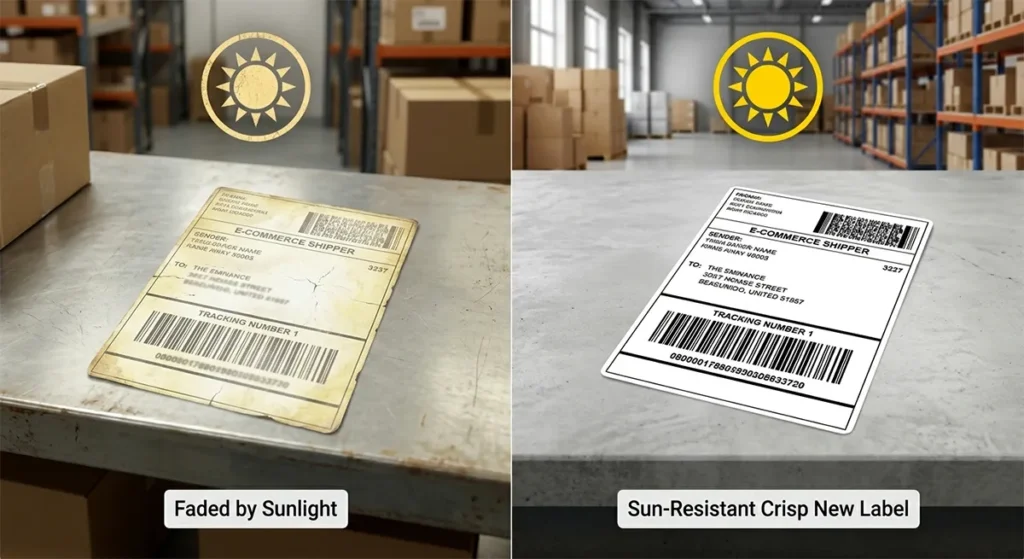
If any of those three conditions match where your labels will live after printing, thermal transfer is not a preference. It is required.
How Thermal Transfer Printing Works
A thermal transfer printer uses a ribbon roll mounted inside the printer housing. The ribbon consists of a thin polyester base film, a release layer, an ink layer made from wax, resin, or a blend of both, and a back coating that protects the printhead from friction and static during the printing process.
A thermal transfer printer feeds the label and ribbon together past the printhead. Heat melts ink from the ribbon’s ink layer and physically bonds it to the label surface. Unlike the reactive dye coating in direct thermal labels, the image is embedded into the substrate. That is why thermal transfer prints survive the three conditions that destroy direct thermal output.
The Three Ribbon Types: Wax, Wax-Resin, and Resin
Ribbon selection is as important as label material selection. A mismatch between ribbon type and label substrate produces poor print quality and accelerates printhead wear.
Wax ribbons are the most economical option. They melt at low temperatures around 65°C (149°F), which makes them fast to print and gentle on the printhead. Wax ribbons work on paper labels including both coated and uncoated varieties. They resist basic moisture and handling but fail under chemicals, abrasion, and heat exposure. Wax ribbons make up over 70% of all thermal transfer ribbon sales, according to Barcoding Inc.. Shipping labels, price tags, retail shelf labels, and warehouse inventory bins stored indoors are all appropriate wax ribbon applications.
Wax-resin ribbons blend wax and resin to produce harder, more durable prints. They handle coated paper and synthetic substrates and offer better scratch resistance, moisture resistance, and moderate chemical resistance compared to pure wax. The wax-resin is the versatile catch-all for applications that fall between basic indoor shipping and full industrial durability. Product labels, retail shelf labels, and frequently handled inventory labels are typical wax-resin use cases.
Resin ribbons are the industrial-grade option. They melt at higher temperatures and create the most durable print available from a thermal transfer printer. Resin ribbons bond to synthetic label materials including polyester (PET), polypropylene (PP), and vinyl. The output resists extreme temperatures, aggressive chemicals, UV exposure, and sustained abrasion. Silver Fox notes that resin ribbons are required for applications where labels must remain legible for years or decades in harsh environments. Chemical drum labels, outdoor asset tags, laboratory specimen labels, medical device labeling, and compliance certification labels all require resin ribbons on synthetic substrates.
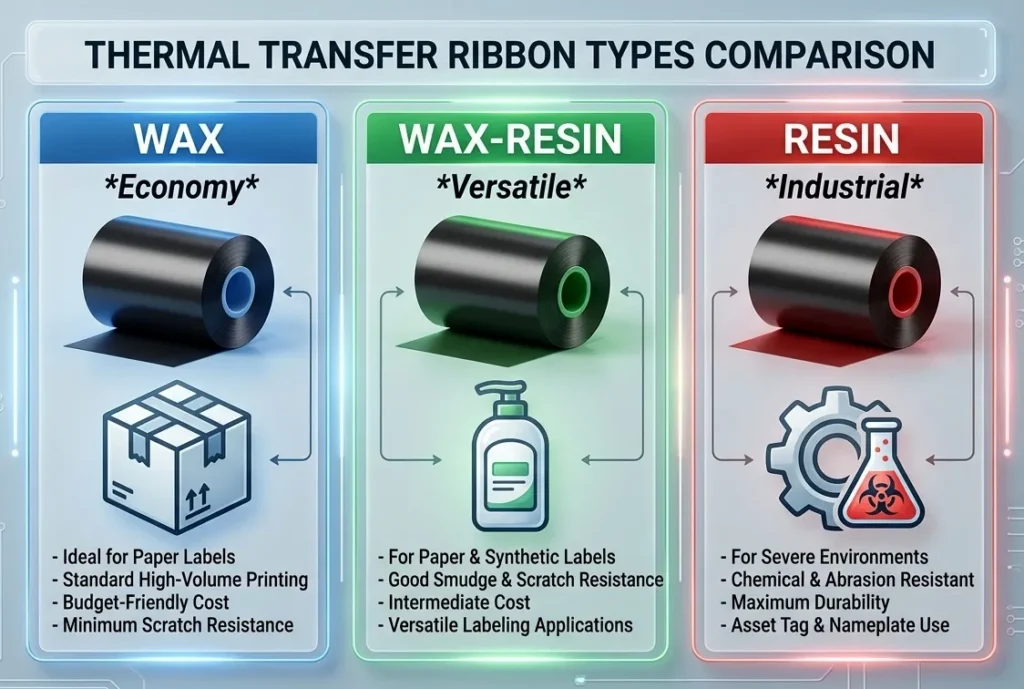
Per Label Blanks, each ribbon type covers a distinct durability range, and choosing the wrong one for your substrate is the most common and avoidable thermal transfer mistake.
How Long Thermal Transfer Labels Last
Thermal transfer label lifespan is not a single number. It depends on three variables: ribbon type, label substrate, and the environment the label lives in.
Wax ribbon on paper: 1 to 3 years in normal indoor storage. Wax-resin ribbon on coated paper or synthetic: 3 to 5 years in controlled environments. Resin ribbon on polyester or polypropylene: 5 to 35 years, with the upper range achieved in archival, low-UV conditions.
For most small business sellers, the practical range is 2 to 5 years on product labels stored in normal indoor conditions. That is enough to outlast any product sitting on a retail shelf or in a warehouse bin.
What Thermal Transfer Printing Costs Beyond the Printer
Thermal transfer introduces a second consumable: the ribbon. According to Printrunner, ribbon cost runs approximately $2 to $8 per 1,000 four-by-six labels depending on ribbon type and coverage. Wax ribbons sit at the lower end of that range. Resin ribbons sit at the higher end.
A standard 450-meter ribbon roll produces approximately 2,800 six-inch labels, as documented by SATO America. At 20 labels per minute in a production environment, that roll runs out approximately every 2.5 hours. At 8 hours of continuous operation per day, a full year of production generates roughly 144 hours of ribbon changeover downtime. SATO notes that industrial printers with 600-meter large-capacity ribbon rolls reduce that figure substantially.
There is one cost advantage thermal transfer has over direct thermal that rarely gets mentioned: printhead lifespan. According to HPRT, the thermal transfer ribbon acts as a protective layer between the printhead and the label surface, extending printhead life by 2 to 3 times compared to direct thermal use. Printrunner puts the printhead life extension at roughly 20 to 30 percent under comparable conditions.
In direct thermal printing, the label surface makes direct, abrasive contact with the printhead on every single pass. Dust, adhesive residue, and label coating debris accumulate on the printhead elements and accelerate wear. SATO America confirms that foreign materials pulled across the direct thermal printhead can burn onto the elements or cause premature failure.
At high daily volumes, the math on printhead replacement frequency often tips the total cost of ownership toward thermal transfer.
Direct Thermal vs Thermal Transfer: Side-by-Side Comparison
| Attribute | Direct Thermal | Thermal Transfer |
|---|---|---|
| Ribbon required | No | Yes (wax, wax-resin, or resin) |
| Label lifespan | 6 to 12 months | 2 to 35 years |
| Cost per label | $0.02 to $0.05 | $0.04 to $0.13 (label + ribbon) |
| Printhead lifespan | Shorter (direct label contact) | 2 to 3x longer (ribbon acts as buffer) |
| Media compatibility | Heat-sensitive paper only | Paper, polyester, polypropylene, vinyl |
| UV resistance | Poor, fades within weeks outdoors | Good to excellent with resin ribbon |
| Chemical resistance | None | Excellent with resin ribbon |
| Heat resistance | Fails above 60°C ambient | Survives wide temperature ranges |
| Moisture resistance | Limited | Good (wax-resin), excellent (resin) |
| Color printing | Black only | Yes, colored ribbons available |
| Printer complexity | Low | Higher, ribbon threading required |
| Best for | Shipping labels, receipts, tickets, temporary warehouse barcodes | Product labels, freezer labels, outdoor labels, asset tags, compliance labels |
Which Print Method Do You Need? A Use Case Decision Guide
Use Direct Thermal If…
Your label ships on a package that gets delivered within days or a few weeks. You printshipping labels for Etsy, Shopify, eBay, or Amazon using USPS, UPS, or FedEx standard 4×6 label formats. You want the simplest printer setup with one consumable and zero ribbon management. Your storage and fulfillment area is climate-controlled, away from sunlight and chemical exposure.
The entire Rollo, DYMO LabelWriter, and entry-level Zebra ZSB product line runs on direct thermal. Every one of those printers is designed for the use case where label lifespan does not need to exceed 6 to 12 months.
Use Thermal Transfer If…
Your labels need to stay readable for more than 12 months. They go on products that sit in a warehouse, on a retail shelf, or in outdoor storage. They face chemical exposure, moisture, or temperature extremes after printing. You print freezer labels for food products, chemical drum labels, laboratory specimen labels, outdoor asset tags, or compliance and certification labels. You need barcode scan reliability beyond 12 months in the field. The environment makes the decision here, not preference.
Can One Printer Handle Both?
Yes. Several thermal transfer printer models support both direct thermal and thermal transfer printing within the same unit. The Zebra ZD421 is the most commonly used dual-mode printer in small and mid-size business environments. It switches between modes through the printer driver or web configuration interface. In direct thermal mode, you remove the ribbon and print directly onto heat-sensitive label stock. In thermal transfer mode, you load a ribbon roll and print onto paper, synthetic, or specialty substrates.
Dual-mode printers cost more upfront. For sellers or businesses that print both short-life shipping labels and longer-life product labels regularly, one dual-mode printer eliminates the need for two separate units.
For a full setup guide on the Zebra ZD421 covering dual-mode configuration, ZPL language support, and compatible label media, see our Zebra thermal label printer guide.
Frequently Asked Questions
Do direct thermal printers need ink?
No. The label roll is the only consumable. The leuco dye coating built into the label surface produces the image when the printhead applies heat. Inkjet printing at moderate shipping volume costs $300 to $500 per year in ink alone. While Direct thermal eliminates that cost entirely with $0.02 to $0.05 for each thermal label, which is the primary reason online sellers switch.
How long do direct thermal labels last?
Direct thermal labels last 6 to 12 months under normal indoor storage conditions. In air-conditioned, low-humidity, low-light environments, topcoated labels can approach 24 months. In hot, sunny, or humid conditions, labels can begin fading in as little as 4 to 6 months. For shipping labels that travel on a package for a few days, none of that matters.
Which ribbon should I use for my thermal transfer printer?
Use wax ribbon for paper labels stored indoors with normal handling. Use wax-resin ribbon for coated paper or synthetic labels that face moderate moisture, scratch exposure, or frequent handling. Use resin ribbon for synthetic labels (polyester, polypropylene, vinyl) that need to survive chemicals, outdoor conditions, extreme temperatures, or years of exposure. For a detailed breakdown with ribbon-to-label compatibility charts, see our thermal transfer ribbon guide.
Can thermal transfer printers print in color?
Yes. Thermal transfer printers support colored ribbon rolls in red, blue, green, yellow, white, and other colors. Color thermal transfer is used for product branding labels, warning labels requiring specific colors per regulatory standards, and apparel care tags. Color ribbons are a niche application. The vast majority of thermal transfer printing for shipping, inventory, and product labels uses black ribbon on white or off-white label stock.
What label sizes do direct thermal and thermal transfer printers support?
Both print methods support the same range of label sizes. The 4×6 inch format is the universal standard for USPS, UPS, FedEx, and DHL shipping labels in the United States. Smaller sizes including 2×1, 3×2, 4×4, and custom dimensions are available in both direct thermal and thermal transfer stocks. The key difference is that thermal transfer offers a wider range of label materials within those sizes: paper, polyester, polypropylene, and vinyl. Direct thermal is available in paper only. For a full breakdown of label sizes and material types, see our thermal label types and sizes guide.
This article was written by Kamran Asghar, founder of GadgetsChamp. Technical specifications and durability figures were verified from primary industry sources linked in the article. Last updated: March 2026.
Affiliate Disclosure: GadgetsChamp participates in the Amazon Associates program. If you buy through a link on this page, we earn a small commission at no extra cost to you. Kamran Asghar wrote this guide based on verified manufacturer technical documentation, independent industry sources, and direct experience using thermal label printers for Etsy and Shopify fulfillment. No brand paid for placement here.