
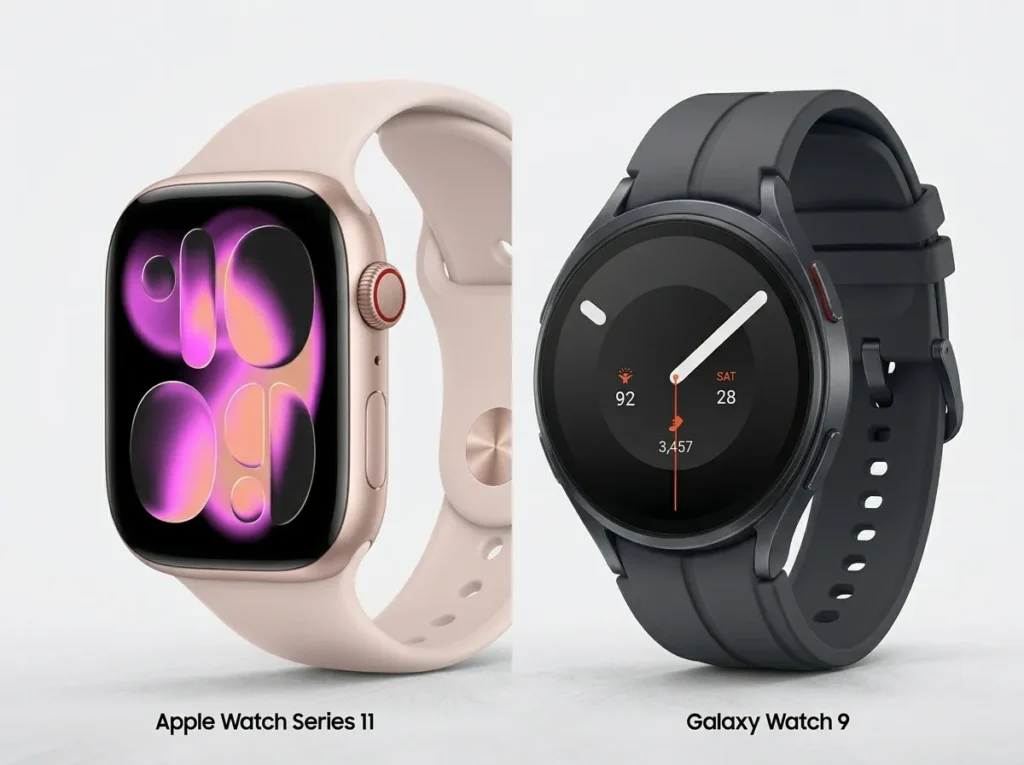
The biggest mistake in the Apple Watch vs Samsung Galaxy Watch debate is comparing the watches before checking your phone.
Your ecosystem can eliminate one option immediately. Apple Watch Series 11 requires an iPhone 11 or later running iOS 26 or later, while Samsung’s newer Wear OS Galaxy Watches do not work with iPhone.
That makes the decision much simpler than a giant specification chart suggests.
For 2026, we’re comparing the Apple Watch Series 11 with the Samsung Galaxy Watch9. Galaxy Watch9 starts at $379.99 for the Bluetooth model in the US, while Apple Watch pricing varies by configuration and should be checked before purchase.
If you own an iPhone, Apple Watch is the clear ecosystem choice. If you use Android, Galaxy Watch9 is the logical choice.
Affiliate Disclosure: As an Amazon Associate, GadgetsChamp earns from qualifying purchases. We may earn a small commission if you purchase through our links. No extra cost to you. Our recommendations remain independent.
Everything else comes down to battery life, health tracking, fitness, design, software and the compromises you’re willing to accept.
For more buying context, see our smartwatch buying guide before spending several hundred dollars.
Apple Watch vs Galaxy Watch: Quick Verdict
Apple Watch Is Better for iPhone Owners
If you use an iPhone, the Apple Watch Series 11 makes the stronger overall choice.
Apple designs the watch and iPhone to work together, and Series 11 requires an iPhone 11 or newer with iOS 26 or later. That tight connection matters for notifications, Apple Health, apps, safety features and the broader Apple workflow.
The trade-off is charging.
Apple rates Series 11 for up to 24 hours of normal use and up to 38 hours in Low Power Mode. It can also charge quickly, reaching up to 80% in about 30 minutes.
Winner for iPhone: Apple Watch Series 11.
Galaxy Watch 9 Is Better for Android Owners
Galaxy Watch9 makes more sense if you use Android.
It runs Wear OS powered by Samsung and combines Samsung Health with Google’s wearable ecosystem. Samsung also gives you a round watch design, 40mm and 44mm options, and a claimed battery life of up to 40 hours with the always-on display off or 30 hours with it on.
Non-Samsung Android phones can work with Galaxy Watches, although some features can have limited support. Samsung specifically notes that some features are reserved for Samsung phones.
Winner for Android: Galaxy Watch9.

![Apple Watch Series 11 [GPS 42mm] Smartwatch with Rose Gold Aluminum Case with Light Blush Sport Band - S/M. Sleep Score, Fitness Tracker, Health Monitoring, Always-On Display, Water Resistant](https://m.media-amazon.com/images/I/31caPPnRysL._AC_.jpg)
The Phone You Own Changes the Winner
Use this decision tree before comparing anything else:
- iPhone → Apple Watch Series 11
- Samsung Galaxy phone → Galaxy Watch9
- Other compatible Android phone → Galaxy Watch9
- Considering switching phones → compare the ecosystem cost first
Don’t buy a new phone just to justify a smartwatch purchase.
Apple Watch vs Galaxy Watch: Side-by-Side Comparison
The headline specifications matter, but only when you translate them into daily ownership.
| Category | Apple Watch Series 11 | Galaxy Watch 9 | Winner |
|---|---|---|---|
| Phone compatibility | iPhone 11+ with iOS 26+ | Compatible Android phones | Depends |
| Battery | Up to 24 hours normal use | Up to 40 hours AOD off | Galaxy |
| Display | LTPO3 OLED, up to 2,000 nits | Super AMOLED | Depends |
| Health | Apple health ecosystem | Samsung Health ecosystem | Depends |
| Fitness | Strong workout ecosystem | Strong workout ecosystem | Depends |
| Apps | watchOS ecosystem | Wear OS + Google Play | Depends |
| Durability | 5ATM, model-dependent protection | 5ATM, IP68, MIL-STD-810H | Galaxy |
| Cellular | 5G option | LTE option | Depends |
Apple lists an always-on Retina display with wide-angle OLED and LTPO3 technology, plus peak brightness up to 2,000 nits. Samsung lists a Super AMOLED display, 5ATM durability and 32GB storage for Galaxy Watch9.
The important point is that there isn’t a universal winner across every row. Your phone ecosystem still carries more weight than processor or storage numbers.
Which Watch Is Better for Daily Use?
Software and App Experience
Apple Watch Series 11 uses watchOS, while Galaxy Watch9 uses Wear OS powered by Samsung.
That difference affects how the watch fits into your day.
With Apple, the appeal is the connected Apple workflow. Your watch fits naturally alongside the iPhone and Apple Health.
Galaxy Watch9 takes a different route. Wear OS gives it access to Google’s wearable ecosystem, while Samsung adds its own health and customization features. Samsung also integrates Google Gemini on Galaxy Watch9 for voice-based assistance.
So Apple wins for iPhone integration, while Galaxy Watch9 wins for Android flexibility.
Neither choice makes much sense outside its intended phone ecosystem.
Comfort, Design and Display
The design difference is obvious.
Apple Watch uses a rectangular case, while Galaxy Watch9 uses a round watch-style design. Galaxy Watch9 comes in 40mm and 44mm sizes, giving Android buyers two straightforward sizing options.
That matters more than a specification sheet suggests.
If you prefer a traditional watch appearance, Galaxy Watch9 has the stronger case. If you prefer Apple’s rectangular interface and existing Apple Watch design language, Series 11 is the better fit.
Apple also claims up to 2,000 nits of peak brightness on Series 11.
Battery Life and Charging
This is one of the clearest hardware differences in the Apple Watch vs Galaxy Watch battery life comparison.
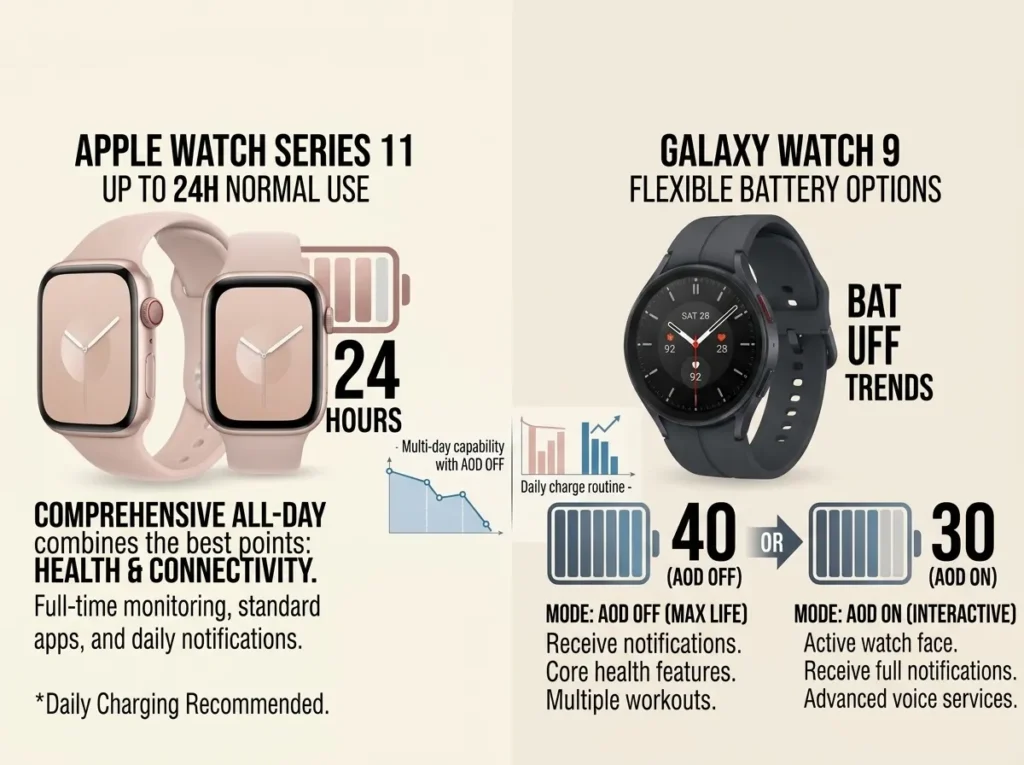
Apple rates Series 11 for up to 24 hours of normal use and up to 38 hours in Low Power Mode. Samsung rates Galaxy Watch9 for up to 40 hours with AOD off and 30 hours with AOD on.
That does not mean you’ll automatically get those numbers.
GPS, cellular use, workouts, screen settings and health monitoring can change real-world endurance.
Still, Samsung has the easier battery story. A Galaxy Watch9 owner has more room between charges, especially with AOD disabled.
If charging frequency annoys you, explore our guide to smartwatches with the best battery life.
Battery winner: Galaxy Watch9.
Which Watch Tracks Health & Fitness Better?
Heart Rate, ECG and Health Tracking
Both watches take health tracking seriously, but they organize that data around different ecosystems.
Apple Watch Series 11 includes ECG, heart-rate notifications, sleep tracking, sleep score, sleep apnea notifications and hypertension notifications. Apple also lists Blood Oxygen features, subject to regional availability and restrictions.
Galaxy Watch9 includes an optical heart-rate sensor, electrical heart sensor, temperature sensor, bioelectrical impedance analysis sensor and other motion sensors. Samsung positions the watch around Samsung Health and daily health insights.
The important distinction is this:
More sensors do not automatically mean more accurate health data.
Sensor performance depends on the measurement, software, fit, movement and other conditions. We should not declare one watch universally more accurate without controlled testing of the same activities.
For a deeper technical explanation, see how smartwatch sensors work.
If heart-rate tracking is your priority, our heart rate monitor smartwatch guide covers that attribute in greater detail.
Sleep Tracking and Recovery
Sleep is another area where both brands have built substantial software around the hardware.
Apple Watch Series 11 tracks sleep stages and provides a sleep score. Apple also lists sleep apnea notifications among its health features.
Galaxy Watch9 includes sleep tracking and Sleep Coaching, while Samsung promotes broader health insights through Samsung Health.
For overnight use, battery becomes part of the health equation.
A watch that needs charging at inconvenient times can create gaps in overnight tracking. Galaxy Watch9’s longer claimed battery life gives it an advantage here, while Apple’s fast charging reduces some of the inconvenience.
GPS and Workout Tracking
Both watches support GPS-based activity tracking and cover common workouts such as walking, running and cycling.
Galaxy Watch9 includes GPS, GLONASS, Beidou, Galileo and QZSS positioning systems.
Apple Watch Series 11 also targets fitness and outdoor activity through its workout and location features.
But don’t confuse GPS support with proven GPS accuracy.
I cannot confirm that one current model is universally more accurate from the available evidence here. A fair accuracy verdict requires controlled side-by-side testing across the same routes and conditions.
If GPS tracking is your main reason for buying, compare both against the requirements in our GPS smartwatch guide.
Apple Watch vs Galaxy Watch: Who Should Buy Which?
Buy Apple Watch If You Have an iPhone
Choose the Apple Watch Series 11 if:
- You already own an iPhone.
- You use Apple Health regularly.
- You want tight iPhone integration.
- You care about Apple’s safety and health ecosystem.
- You prefer watchOS and its app ecosystem.
- You can live with more frequent charging.
Verdict: For an iPhone owner, Apple Watch Series 11 is the better buy.
Check Apple Watch Series 11 Current Price
Buy Galaxy Watch9 If You Use Android
Choose the Galaxy Watch9 if:
- You use a Samsung Galaxy phone.
- You use another compatible Android phone.
- Battery life matters more than charging convenience.
- You prefer a round watch design.
- You use Samsung Health.
- You want Wear OS and Google services.
Samsung lists Galaxy Watch9 from $379.99 for the US Bluetooth model, with LTE configurations priced higher. Current prices can change, so verify the live listing before purchasing.
Verdict: For Android buyers, Galaxy Watch9 is the stronger choice.
Check Galaxy Watch9 Current Price
Don’t Switch Phones Just for the Watch
This is the part many comparison articles skip.
If you already own an iPhone, don’t buy an Android phone just because Galaxy Watch9 has better battery life.
The same applies in reverse.
A smartwatch is an accessory to your phone. Switching ecosystems can mean changing your apps, cloud services, accessories and everyday workflow.
The smarter move is usually to keep your existing phone ecosystem and buy the watch that fits it.
Final Verdict: Which One Should You Buy?
The Apple Watch vs Samsung Galaxy Watch decision looks complicated until you put the phone first.
| Buyer | Winner |
| iPhone owner | Apple Watch Series 11 |
| Android owner | Galaxy Watch9 |
| Samsung phone owner | Galaxy Watch9 |
| Battery priority | Galaxy Watch9 |
| Apple Health ecosystem | Apple Watch Series 11 |
| Samsung Health ecosystem | Galaxy Watch9 |
| Round watch design | Galaxy Watch9 |
| Apple safety and health workflow | Apple Watch Series 11 |
| Unsure about switching ecosystems | Keep your current phone ecosystem |
So, Galaxy Watch vs Apple Watch which is better? Neither wins for everyone.
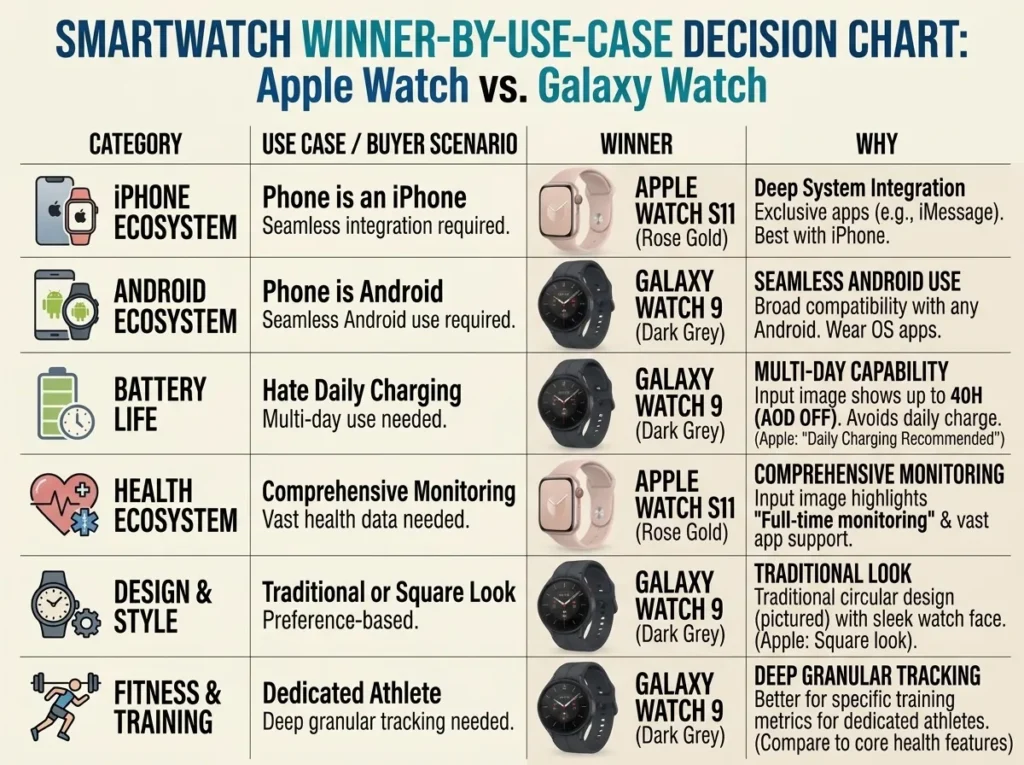
Apple Watch Series 11 wins for iPhone owners. Galaxy Watch9 wins for Android owners and buyers who prioritize battery life or a round design.
That is the honest answer.
Don’t let a longer specification list override the ecosystem you already use every day.
iPhone → Check Apple Watch Price
Android → Check Galaxy Watch9 Price
Frequently Asked Questions
Is Apple Watch Better Than Galaxy Watch?
For iPhone owners, yes. Apple Watch Series 11 integrates directly with the iPhone and requires an iPhone 11 or later with iOS 26 or later. Galaxy Watch9 is designed for compatible Android phones. For Android buyers, Galaxy Watch9 is the better fit because Apple’s watch cannot provide the same ecosystem integration on Android.
Can Galaxy Watch9 Work With an iPhone?
No. Samsung says newer Galaxy Watches running Wear OS are not compatible with iOS. Galaxy Watch9 belongs to this Wear OS generation, so iPhone owners should choose an Apple Watch instead. Older Samsung watches had iPhone support, but that does not apply to current Wear OS models.
Which Is Better for Android, Apple Watch or Galaxy Watch?
Galaxy Watch9. Apple Watch requires an iPhone for setup and compatibility. Galaxy Watch9 is designed for compatible Android phones and works with Samsung’s Galaxy Wearable ecosystem. Some features work best with Samsung phones, so non-Samsung Android owners should check feature compatibility before buying.
Which Has Better Battery Life?
Galaxy Watch9 has the stronger official battery claim. Samsung rates it for up to 40 hours with the always-on display off and up to 30 hours with it on. Apple rates Series 11 for up to 24 hours of normal use. Actual endurance varies with GPS, cellular, display and health-tracking settings.
Which Tracks Health Better?
There is no honest universal winner without controlled testing. Apple Watch Series 11 includes ECG, heart-rate notifications, sleep tracking, sleep apnea notifications and hypertension notifications. Galaxy Watch9 offers heart-rate, electrical heart, temperature and other sensors through Samsung Health. Feature availability can vary by region.
Which Is Better for Fitness Tracking?
Both are strong choices for general fitness, including workouts, walking, running and cycling. Your ecosystem should decide the purchase first. Galaxy Watch 9 is the better Android choice, while Apple Watch Series 11 makes more sense for iPhone users. For advanced fitness needs, compare the specific workout and GPS features you actually use.
Which Has Better GPS?
I cannot confirm a universal GPS winner from the available evidence. Galaxy Watch 9 supports GPS alongside GLONASS, Beidou, Galileo and QZSS. Apple Watch Series 11 also supports location tracking for workouts and outdoor activities. A true accuracy verdict requires controlled side-by-side testing on identical routes and conditions.
Should I Buy Apple Watch Series 11 or Galaxy Watch 9?
Start with your phone. Choose Apple Watch Series 11 if you use an iPhone. Choose Galaxy Watch9 if you use Android. Among compatible buyers, Galaxy Watch9 has the battery advantage, while Apple Watch has the stronger iPhone ecosystem. Don’t switch phones solely to use the other watch.
How We Compared These Watches
This comparison uses current manufacturer specifications, compatibility requirements, software ecosystem information, health features, battery claims and current US pricing.
We have not represented unverified hands-on testing as personal testing. Battery figures are manufacturer claims, not guaranteed real-world results.
Disclaimer: For health features, treat smartwatch measurements as consumer health information rather than a replacement for professional diagnosis. Accuracy can vary by feature, region, device fit and individual conditions.
Author Bio: Kamran Asghar
As an experienced affiliate content writer and wearable tech enthusiast, I have personally tested dozens of smartwatches and fitness trackers. My expertise is rooted in a deep understanding of E-E-A-T principles, focusing on providing trustworthy, firsthand reviews and detailed technical analysis to help readers make the best purchasing decisions. My work is dedicated to translating complex tech specifications into clear, actionable advice.