
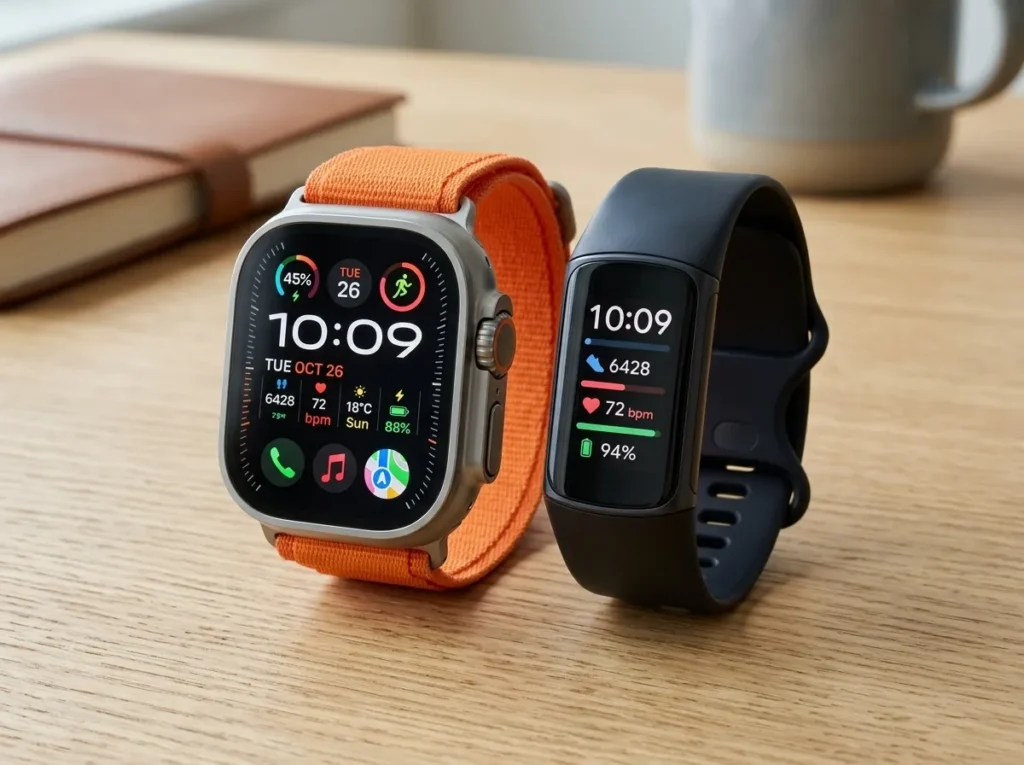
The most expensive wearable isn’t automatically the better one.
If you’re asking smartwatch vs fitness band which is better, the real question is simpler: what will you actually use every week? A smartwatch gives you apps, calls, richer notifications, GPS and more ways to interact with your phone. A fitness band focuses on activity, heart rate, sleep and simpler health tracking in a smaller package.
The gap between these categories has also blurred. Some fitness bands now offer smartwatch-style features, while smartwatches have become serious fitness and health tools.
Here’s the trade-off: if you want simple tracking and low ownership hassle, a fitness band usually makes more sense. If you need calls, apps, navigation or deeper phone interaction, the smartwatch earns its higher price.
Affiliate Disclosure: As an Amazon Associate, GadgetsChamp earns from qualifying purchases. We may earn a small commission if you purchase through our links, at no extra cost to you.
If you’re still comparing models after choosing your category, our smartwatch reviews and buying guides can help you narrow down the options.
Smartwatch vs Fitness Band: What’s the Difference?
What a Smartwatch Does
A smartwatch is essentially a small computer for your wrist. Along with health and activity tracking, it can handle notifications, messages, calls, apps and other phone-connected tasks.
Depending on the model, you can also get:
- Built-in GPS
- Navigation
- Contactless payments
- Music controls
- Voice assistants
- Workout tracking
- Heart-rate monitoring
- Sleep tracking
- Bluetooth or cellular connectivity
The important point is that more features don’t automatically mean more value. If you never answer calls or use apps from your wrist, those extras may not justify the higher price.
What a Fitness Band Does
A fitness band, also called a fitness tracker, puts more emphasis on activity and health tracking.
Most models focus on things such as:
- Steps and daily activity
- Heart-rate monitoring
- Sleep tracking
- Workout tracking
- Calories and movement
- Basic notifications
- Lightweight, comfortable wear
The trade-off is straightforward. You usually get fewer smart features, but the smaller design and simpler software can make the device easier to wear continuously.
Smartwatch vs Fitness Band Compared
If you’re comparing fitness tracker vs smartwatch, start with the attributes that affect everyday ownership rather than the longest specification sheet.
| Feature | Smartwatch | Fitness Band |
|---|---|---|
| Health tracking | Excellent | Excellent |
| Smart features | Winner | Limited |
| Battery life | Usually weaker | Winner |
| Comfort | Depends on size | Winner |
| Apps | Winner | Limited |
| Calls | Winner | Usually limited |
| Notifications | Winner | Basic |
| GPS | Usually stronger | Model dependent |
| Sleep tracking | Very good | Often easier to wear overnight |
| Price | Usually higher | Usually lower |
| Minimalist use | Less focused | Winner |
There isn’t one universal winner for every row. GPS, sensors, sleep features and phone compatibility vary by model.
That’s why fitness tracker vs smartwatch comparisons should focus on the actual device you’re considering, not just the category label.
For example, before paying extra for a smartwatch, use our smartwatch buying guide to check which features actually matter for your use case.
Which One Is Better for Your Lifestyle?
This is where the smartwatch vs fitness tracker decision becomes much easier.
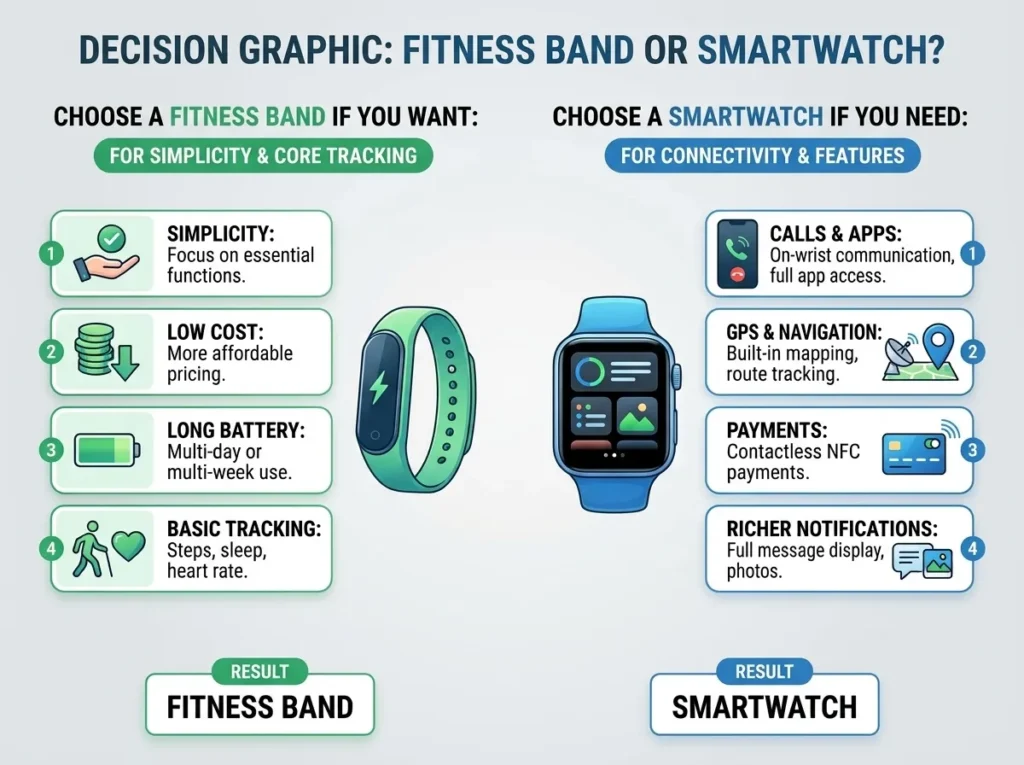
Choose a Fitness Band If You Want Simplicity
A fitness band makes more sense when your main goal is tracking rather than interacting.
It’s a strong choice if you want:
- Steps and daily activity
- Basic workout tracking
- Heart-rate trends
- Sleep tracking
- A lightweight device
- Long battery life
- Fewer distractions
- A lower purchase price
For a budget buyer, this can be the smarter purchase. You’re paying for the functions you need instead of paying extra for a miniature app platform on your wrist.
If price is your biggest concern, compare your options with our guide to smartwatches under $50 before moving into more expensive models.
Choose a Smartwatch If You Want More Than Tracking
A smartwatch earns its higher price when you actually use its smart features.
Choose one if you regularly want to:
- Answer or make calls
- Read and respond to messages
- Use apps
- Navigate with GPS
- Control music
- Make payments
- View richer notifications
- Use a larger touchscreen
This is the main reason to buy a smartwatch.
If you only want step counts and sleep data, the extra functionality can become expensive clutter. If you want your wrist to handle tasks that normally require your phone, the equation changes.

- Stunning images, smooth touch: Immerse yourself in brilliant clarity with the large 1.72-inch AMOLED display.Vacuum fill…
- Fast charging, longer adventures: Say goodbye to daily charging hassles! Enjoy an exceptional 21 days of battery life on…
- Revolutionize your swimming and training sessions: The Xiaomi smartwatch is equipped with a new high-precision electroni…
Choose a Fitness Band for Minimalist Wear
Here’s a question most comparison articles don’t ask:
If you don’t want another tiny smartphone on your wrist, why buy one?
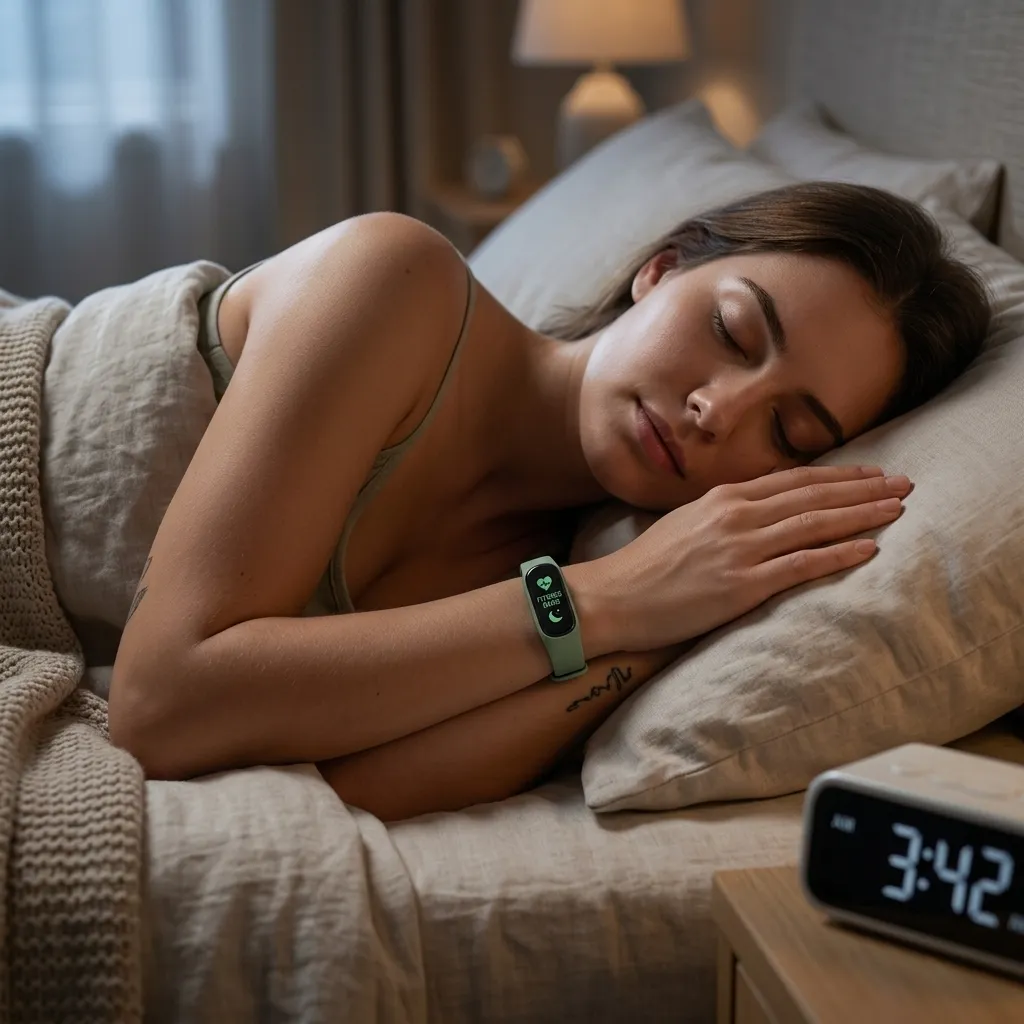
A fitness band can be the better choice precisely because it does less.
Its smaller form can feel less intrusive during sleep, workouts and everyday wear. You may also spend less time managing apps, charging the device and deciding which notifications deserve your attention.
That’s not a compromise for everyone. For a minimalist buyer, simplicity is a feature.
Choose a Smartwatch for Phone Independence
A smartwatch can reduce how often you reach for your phone, especially when it supports cellular or LTE connectivity.
But don’t confuse cellular connectivity with every smartwatch being phone-independent.
Many smartwatches still depend heavily on a paired smartphone for setup, data, apps or certain features. Cellular models can also introduce additional service costs.
So ask yourself whether phone independence is something you’ll actually use. If you won’t leave your phone behind, Bluetooth connectivity may be enough.
Where the Smartwatch Wins, and Where It Doesn’t
Smart Features and Connectivity
The smartwatch wins.
There isn’t much debate here. A smartwatch generally gives you a larger interface, more apps, richer notifications and better interaction with your phone.
Calls and messaging can also make a smartwatch worthwhile for people who want quick access without pulling out a phone.
Fitness bands can show notifications on some models, but they generally don’t offer the same depth of interaction.
Fitness and Health Tracking
This is much closer to a tie.
A fitness band can handle the core metrics many people actually care about, including activity, heart rate, workouts and sleep.
Some smartwatches add more sensors, training features and health functions. But don’t assume that a smartwatch is automatically more accurate because it costs more.

- Inflatable Watch that Measures Blood Pressure: The smartwatch is equipped with an inflatable airbag strap and combines a…
- Automatically Sleep Monitor and Activity Tracker: The sleep monitor watch can monitor sleep quality (18:00-12:00) accura…
- 1.95” Full Touch Screen and Customizable Dials: This mens smart watch is equipped with a 1.95‘’ ultra-clear full-touch …
Sensor implementation, software and the individual model matter.
For a deeper explanation of the technology behind wearable measurements, see our guide on how smartwatch sensors work.
Battery and Sleep Tracking
The fitness band usually wins on ownership convenience.
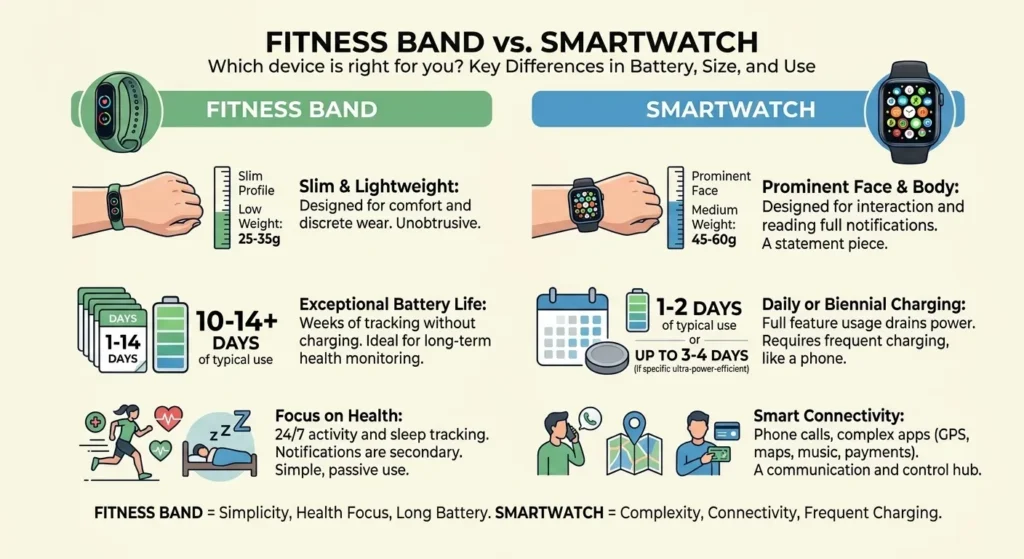
Longer battery life means fewer charging interruptions. That’s particularly useful if you want to wear the device overnight for sleep tracking.
But don’t turn that into an accuracy claim. A fitness band isn’t automatically better at measuring sleep. Its practical advantage comes from being easier to keep on your wrist throughout the night.
If battery life is a priority, compare models rather than relying on the category alone. Our guide to smartwatches with long battery life is a useful next step.
The Hidden Cost of Buying More Watch
Feature count isn’t the same as feature value.
This is the biggest question to ask before buying either device:
How many smartwatch features will I actually use every week?
Imagine your checklist contains only:
- Steps
- Sleep
- Heart rate
- Workouts
- Basic notifications
A fitness band may cover most of what you need.
Now add calls, navigation, payments, apps, richer notifications and cellular connectivity. Suddenly, the smartwatch has a clear reason to cost more.
Your ownership cost can also extend beyond the device itself. Depending on the model, consider:
- Initial purchase price
- Cellular service, if applicable
- Optional subscriptions
- Replacement bands
- Charging accessories
- How often you’ll need to charge it
The hard truth is that paying for unused features is still wasting money.
A $300 wearable isn’t better value than a $70 one simply because it has more functions. The better value comes from the features you use often enough to justify the extra cost.
Smartwatch or Fitness Band: Our Verdict
If you’re wondering smartwatch or fitness tracker which is better, our answer is clear: choose the fitness band unless you have a specific reason to buy the smartwatch.
| Buyer | Winner |
|---|---|
| Budget buyer | Fitness band |
| Minimalist | Fitness band |
| Sleep-focused user | Fitness band |
| Casual fitness | Fitness band |
| Calls and messages | Smartwatch |
| Apps | Smartwatch |
| GPS and navigation | Smartwatch |
| Phone independence | Smartwatch |
| All-in-one wearable | Smartwatch |
For most budget-conscious buyers, the fitness band offers the cleaner value proposition. It handles the core tracking jobs without forcing you to pay for a long list of smart features.
Buy the smartwatch when you can name the smartwatch features you’ll actually use.
That is the simplest answer to smartwatch vs fitness band which is better. Don’t buy the more advanced wearable. Buy the one that fits your routine.
Ready to Pick Your Wearable?
Don’t pay for features you won’t use.
If simple fitness tracking is your priority, compare budget-friendly options first. If you need a full smartwatch, start with our buying guides before spending more.
Or
Frequently Asked Questions
Which Is Better, a Smartwatch or Fitness Band?
For most budget-conscious buyers, a fitness band is the better choice. It covers core tracking such as steps, activity, heart rate and sleep while usually costing less and offering a simpler wearing experience.
Choose a smartwatch when you specifically need calls, apps, navigation, richer notifications, payments or cellular connectivity. The right choice comes down to feature usage, not the number of features listed on the box.
Is a Fitness Band Better for Fitness Tracking?
Not automatically, but it can be more than enough for fitness tracking. Many fitness bands focus heavily on steps, heart rate, workouts and activity data.
A smartwatch can offer more advanced training tools or additional sensors on some models. However, you shouldn’t assume the more expensive category is automatically more accurate. Check the specific model’s sensors, software and documented capabilities.
Should I Get a Fitness Band or Smartwatch?
Get a fitness band if you mainly want health and activity tracking. It’s the better fit for budget buyers, beginners and people who prefer a lightweight wearable.
Choose a smartwatch if you want your wrist to handle calls, messages, apps, navigation or other phone tasks. If you’re unsure, list the five features you’ll use most. That usually makes the decision obvious.
Which Has Better Battery Life?
Fitness bands generally have the battery-life advantage. Their simpler hardware and smaller feature set can reduce charging demands.
Actual battery life varies significantly between models and usage settings. GPS, always-on displays, workouts, cellular connections and frequent notifications can all affect runtime. Compare the manufacturer’s claimed battery life with the features you plan to use.
Is a Smartwatch Worth It for Casual Fitness?
It can be, but casual fitness alone doesn’t justify a smartwatch for everyone. If you only need steps, workouts, heart rate and sleep tracking, a fitness band may deliver better value.
A smartwatch becomes easier to justify when you also want calls, notifications, apps, GPS, payments or other smart features. Don’t spend more simply because the watch offers more.
Are Fitness Bands More Comfortable Than Smartwatches?
Often, yes, especially for overnight wear, but comfort depends on the model and your wrist. Fitness bands typically use a smaller, lighter form factor.
A larger smartwatch can still feel comfortable if the fit works for you. The bigger issue is whether you’ll actually keep wearing it during sleep, workouts and daily activities. A wearable that stays in a drawer provides zero tracking value.
Do Fitness Bands Have GPS?
Some do, but you should check the individual model. A fitness band may include built-in GPS, while another model may rely on connected GPS through your smartphone.
If accurate route tracking matters for running, cycling or outdoor activities, verify the specific GPS implementation before buying. Don’t assume every fitness band or smartwatch handles GPS the same way.
For more specialized GPS requirements, see our guide to GPS tracking smartwatches.
Can a Fitness Band Replace a Smartwatch?
For fitness tracking, sometimes. For apps, calls and richer phone interaction, usually not.
If your definition of a wearable is steps, heart rate, sleep and workouts, a fitness band can cover the job. If you expect your wrist to handle messages, apps, navigation or cellular communication, you’ll usually want a smartwatch.
Author Bio: Kamran Asghar
As an experienced affiliate content writer and wearable tech enthusiast, I have personally tested dozens of smartwatches and fitness trackers. My expertise is rooted in a deep understanding of E-E-A-T principles, focusing on providing trustworthy, firsthand reviews and detailed technical analysis to help readers make the best purchasing decisions. My work is dedicated to translating complex tech specifications into clear, actionable advice.