
Most smartwatch users wear their device 24 hours a day without questioning the flashing lights underneath the case. Those lights and metal contacts act as the engine for your health data. They transform complex biological signals from your wrist into digital numbers on your screen.
To understand why your heart rate reading might jump during a workout or why your doctor trusts some data more than others, you must understand the primary technologies at play.
Smartwatches utilize Photoplethysmography (PPG) for continuous tracking, Electrocardiography (ECG) for medical-grade spot checks, Pulse Oximetry (SpO2) for blood oxygen, and newer models now include Bioelectrical Impedance Analysis (BIA) for body composition. Each method sees your body differently. One uses light to watch blood flow. Another uses electricity to read heart rhythm. A third measures how electricity moves through your tissues.
This guide breaks down every sensor inside a 2026 smartwatch, how each one works, and which readings you can actually trust.
Affiliate Disclosure: As an Amazon Associate, GadgetsChamp earns from qualifying purchases. We may earn a small commission if you purchase through our links. No extra cost to you — always honest, tested, and verified.
Quick Answer: Every Sensor Inside a 2026 Smartwatch
| Sensor | What It Measures | Technology | Key 2026 Models |
|---|---|---|---|
| PPG (Optical Heart Rate) | Heart rate, HRV, sleep stages | Green LED + photodiode | All major watches |
| ECG (Electrical) | Heart rhythm, AFib | Electrical circuit via crown/button | Apple Watch 11, Galaxy Watch 8, Pixel Watch 4 |
| SpO2 (Pulse Oximetry) | Blood oxygen saturation | Red + infrared LEDs | Apple Watch 11, Galaxy Watch 8, Garmin Fenix 8 |
| BIA (Bioimpedance) | Body fat %, muscle mass, hydration | Microcurrent through wrist/fingers | Samsung Galaxy Watch 8 |
| Temperature | Wrist skin temperature trends | Thermistor / infrared | Apple Watch 11, Galaxy Watch 8 |
| Accelerometer | Steps, motion, fall detection | 3-axis force measurement | All major watches |
| Gyroscope | Orientation, rotation, swim strokes | 3-axis angular velocity | All major watches |
| GPS/GNSS | Location, pace, distance | L1 + L5 satellite signals | Garmin Fenix 8, Galaxy Watch 8, Apple Watch 11 |
| Barometer | Elevation, stairs climbed, weather | Air pressure sensor | Garmin Fenix 8, Apple Watch Ultra 3 |
| GSR/EDA | Stress, emotional arousal | Skin conductance | Select Garmin, research devices |
How PPG Sensors Measure Your Heart Rate
Why Green Light Works Best
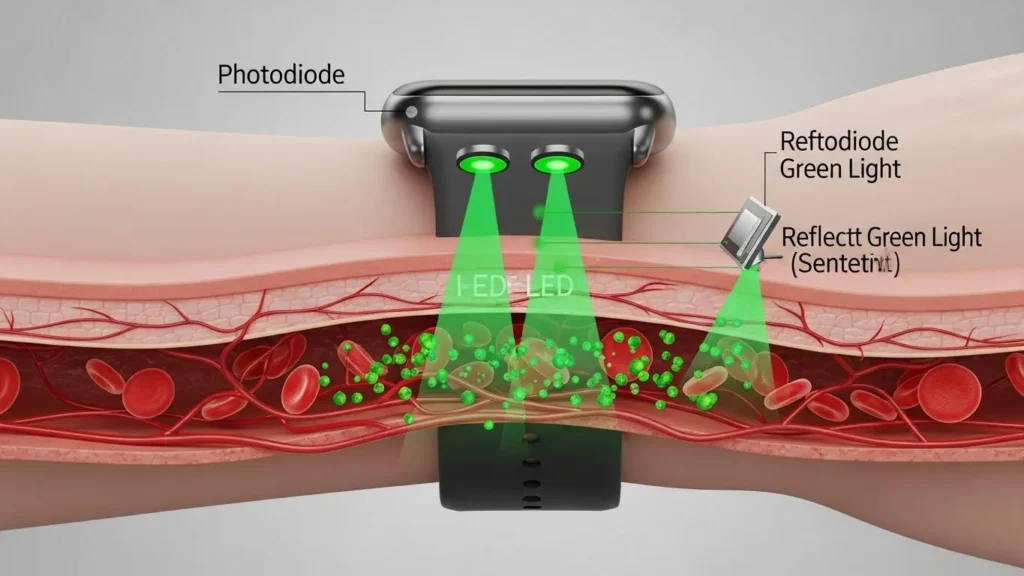
The most common sensor on any budget or premium wearable relies on optical technology. Manufacturers call this the PPG sensor. This component consists of two main parts: a light emitter (LED) and a light receiver (photodiode).
Blood is red because it reflects red light and absorbs green light. PPG sensors take advantage of this physical property. The green LEDs on the back of your watch flash hundreds of times per second. When your heart beats, blood flow to your wrist increases. This higher volume of red blood absorbs more green light. Between beats, blood flow decreases, and absorption drops.
The photodiode measures the changing intensity of the light reflecting back from your skin. The watch’s processor analyzes these light variations to calculate your Beats Per Minute (BPM).
All wrist-worn smartwatches use a reflectance PPG method. The LED and photodiode sit on the same side of the skin. The LED emits light that is absorbed by the skin, and the reflection is made by blood vessels within the capillary bed and is detected by the photodiode. There is no transmission of light passing through the tissue. This makes the sensor inherently direction-agnostic — it works the same whether the watch faces up or down.
Multi-LED Arrays and Dark Skin Compensation
A 2025 validation study in Frontiers in Digital Health compared Garmin PPG sensors across different Fitzpatrick skin types. The research confirmed that darker skin tones can reduce PPG signal quality because melanin absorbs more green light.
Manufacturers have responded. Apple’s third-generation optical heart sensor on the Series 11 increases both LED brightness and sampling rate when signal levels drop. Garmin and Fitbit configure their devices to boost green light intensity when the sensor struggles to detect a pulse.
Some research-grade wearables now use multi-wavelength PPG — combining green, red, and infrared LEDs — to improve accuracy across all skin tones. Red and infrared light penetrates deeper and is less affected by melanin absorption.
Motion Artifacts and the Accelerometer Assist
Optical sensors watch for tiny changes in color. Rhythmic arm movements confuse the sensor. Running or rowing creates “noise” in the data. The watch struggles to separate your pulse from the movement of your arm.
Your watch knows when you are moving. The accelerometer tracks motion along three perpendicular axes. The processor uses this motion data to clean up the heart rate signal. If the accelerometer senses rhythmic stepping, the watch ignores signal noise that matches that rhythm. This helps the sensor focus on the actual heartbeat.
For the most accurate heart rate data during intense exercise, see our best heart rate monitor smartwatch guide for tested picks that passed our stress tests.
How ECG Sensors Read Your Heart’s Electrical Signals
Creating the Circuit on Your Wrist
While PPG estimates heart rate through blood flow, an ECG (Electrocardiogram) measures the electrical timing of the heart itself. This sensor technology mimics the machines found in hospitals but uses a simplified single-lead circuit.
An ECG sensor does not use light. It requires a closed electrical loop to function. This is why you must place a finger from your opposite hand on the watch crown or a specific metal contact point. This action completes a circuit across your chest, allowing the sensor to detect the tiny electrical impulses that tell your heart to beat. The American Heart Association notes that wearable ECGs can help detect atrial fibrillation early.
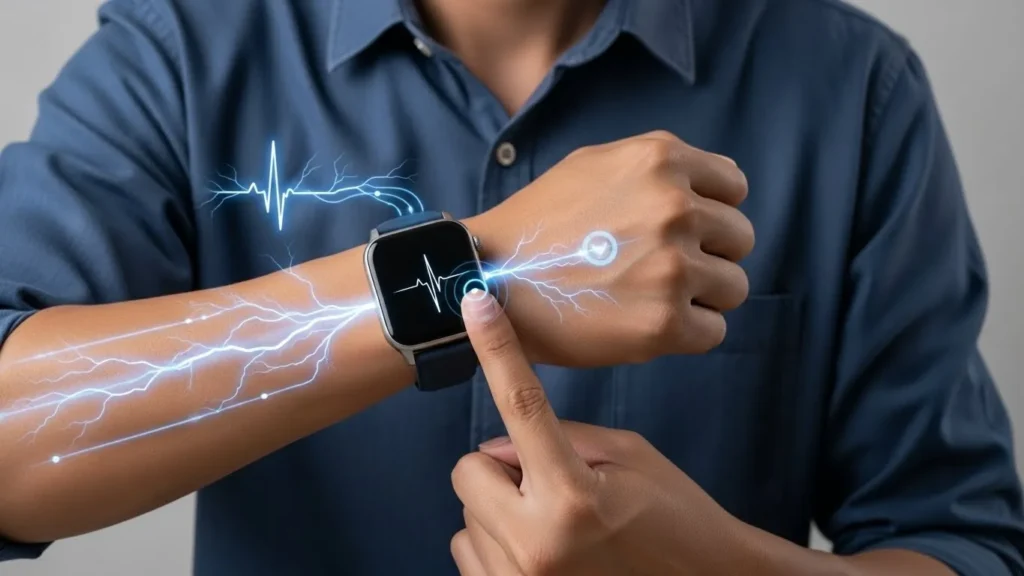
Apple Watch Series 11 uses a second-generation electrical heart sensor. Samsung Galaxy Watch 8 places ECG electrodes on the watch back and bezel. Both require 30 seconds of still contact to record a clean waveform.
What ECG Can Detect That PPG Cannot
The main advantage of ECG over PPG is precision in timing. It captures the specific electrical spike (R-Peak) of every heartbeat. This clarity allows the sensor to detect Atrial Fibrillation (AFib), a common form of irregular heart rhythm. Doctors prefer this data because it shows the electrical pattern rather than just the pulse rate.
A 2025 systematic review and meta-analysis published in BMC Cardiovascular Disorders compared ECG chest patches against PPG smartwatches for AFib detection. PPG smartwatches demonstrated a pooled sensitivity of 97.4% and specificity of 96.6%, while ECG chest patches showed 96.1% sensitivity and 97.5% specificity. Both modalities were highly effective, with PPG showing slightly higher sensitivity and ECG showing marginally greater specificity.
Unlike the optical sensor, an ECG cannot run automatically in the background. It provides a snapshot of your heart health only when you actively take a reading.
If you need a device specifically for heart health metrics, check out our guide on best smartwatches for blood pressure monitoring, which covers watches with both ECG and optical heart rate sensors.
How SpO2 Sensors Measure Blood Oxygen
Red and Infrared Light Penetration
Green light does not penetrate deep enough to measure oxygen levels. Manufacturers use red and infrared LEDs for this. These wavelengths travel deeper into the tissue. Oxygen-rich blood absorbs infrared light differently than oxygen-poor blood. The watch calculates this difference to show your SpO2 percentage.
The sensor needs to be active for 30 seconds to get a good reading. Sampling rates vary by brand:
- Apple Watch 11: Every hour during sleep (if enabled)
- Samsung Galaxy Watch 8: Every 10 minutes during sleep
- Garmin Fenix 8: User configurable — every 2 minutes, 5 minutes, or off
- Google Pixel Watch 4: Every 15 minutes during sleep
If your watch checks SpO2 every 10 minutes for 8 hours, that is 48 readings. Each reading activates sensors for 30 seconds. That is 24 minutes of active sensor time.
Why SpO2 Drains Battery Faster Than Heart Rate
SpO2 sensors stay active for up to 30 seconds per reading, making them the single biggest battery drain during sleep. Continuous monitoring can drain 15-20% overnight by itself. For a deep dive into how SpO2 works and whether you actually need it, read our SpO2 tracking accuracy guide.
How BIA Sensors Estimate Body Composition (New for 2026)
The Galaxy Watch 8 Bioelectrical Impedance Method
Bioelectrical Impedance Analysis (BIA) is the newest sensor category in consumer smartwatches. Samsung introduced it on the Galaxy Watch 4 and refined it through the Galaxy Watch 8. No other mainstream brand offers this yet.
The Galaxy Watch 8 uses four individual electrodes positioned underneath the watch face (two in contact with your left wrist) and within the watch frame (two in contact with your right middle and ring finger). When you place your fingers on the buttons, the watch injects a low-level alternating current at 50 kHz through your upper body.
Different tissues resist the current differently. Muscle and water conduct electricity well. Fat resists it. The watch measures this impedance and runs it through proprietary algorithms to estimate:
- Body fat percentage
- Skeletal muscle mass
- Body water content
Samsung collaborated with Pennington Biomedical Research Center and the University of Hawaiʻi Cancer Center to validate the accuracy of these devices against dual-energy X-ray absorptiometry (DXA).
How Accurate Is Smartwatch BIA?
A 2025 study published in PeerJ compared the Samsung Galaxy Watch 5 BIA against DXA and a clinical standing BIA analyzer (InBody 770). The wearable BIA showed a very strong correlation with DXA for body fat percentage (r = 0.93, CCC = 0.91) with a mean absolute percentage error of 14.3%.
For context, the clinical standing BIA showed a higher error of 21.1% compared to DXA. This means the smartwatch BIA was actually closer to the gold standard than some clinical devices — though absolute values still drift, particularly for skeletal muscle mass.
⚠️ WARNING: Posture matters. The same study found that standing vs. supine position changed body fat readings significantly. Always measure BIA in the same posture for consistent trends.
How Smartwatches Measure Blood Pressure Without a Cuff
Pulse Wave Velocity and Pulse Arrival Time
Cuffless blood pressure monitoring on wearables is based on Pulse Wave Velocity (PWV) — the velocity of the pulse wave across the arteries due to cardiac activity. Blood pressure determines arterial stiffness, which in turn affects PWV.
Today’s wrist-worn devices support both PPG and ECG signal acquisitions. Using the relative delay between the ECG and PPG waveforms, a parameter called Pulse Arrival Time (PAT) can be determined, which correlates to PWV. The ECG signal is acquired using a pair of electrodes — one in contact with the left wrist, the other touched by the finger of the right hand.
Apple Watch Series 11 offers hypertension notifications (FDA-cleared September 2025). It does not show mmHg readings but warns when trends suggest elevated blood pressure. Samsung Galaxy Watch 8 offers on-demand blood pressure in the US (since March 2026), calibrated against an upper-arm cuff every 28 days.
![Apple Watch Series 11 [GPS 42mm] Smartwatch with Jet Black Aluminum Case with Black Sport Band - S/M. Sleep Score, Fitness Tracker, Health Monitoring, Always-On Display, Water Resistant](https://m.media-amazon.com/images/I/41s72HIk5TL._AC_.jpg)
Why Calibration Still Matters
PPG-based blood pressure is fundamentally an estimate. Arterial stiffness, skin tone, hydration, and wrist anatomy all affect the signal. Without regular calibration, readings can drift 10-20 mmHg or more within weeks.
For watches that actually measure blood pressure with a miniature cuff, see our best smartwatch blood pressure guide for clinically validated options.
How Temperature and Stress Sensors Work
Wrist Temperature vs Body Temperature
Most smartwatch temperature features estimate skin temperature changes over time, especially during sleep. They are generally not meant to function as direct body-temperature thermometers.
The wrist is a challenging measurement site. It is exposed to room temperature, sleeves, bedding, hand position, strap tightness, and constant movement. Even when the sensor hardware is accurate to ±0.1°C, the measurement site itself introduces instability.
This is why wrist temperature data works best as a trend signal compared against your personal baseline, not as a precise temperature reading. Apple Watch uses nightly wrist temperature tracking to improve period predictions and retrospective ovulation estimates. Samsung Galaxy Watch 8 uses an infrared temperature sensor for similar cycle tracking features.
Galvanic Skin Response for Stress Tracking
Galvanic Skin Response (GSR), also called Electrodermal Activity (EDA), measures the electrical conductivity of your skin. When you experience stress or emotional arousal, your sympathetic nervous system triggers sweat glands in microscopic amounts. This increases skin conductance.
GSR sensors apply a small voltage between two electrodes and record skin conductance in microsiemens (µS). The signal has two components:
- Skin Conductance Level (SCL): The slow-moving baseline (tonic)
- Skin Conductance Responses (SCR): The fast, event-related spikes (phasic)
While GSR is common in research wearables like the Empatica E4, most consumer smartwatches infer stress indirectly through Heart Rate Variability (HRV) rather than direct GSR measurement. Garmin’s Body Battery and Samsung’s Stress Score both rely primarily on HRV-derived stress estimates.
Motion and Environmental Sensors
Accelerometer vs Gyroscope
The accelerometer measures force along three perpendicular axes. It detects gravity, which lets the watch know which way is up for screen rotation. It also identifies characteristic acceleration patterns for steps, falls, and car crashes.
The gyroscope measures angular velocity — how fast the watch rotates. It complements the accelerometer by detecting orientation changes the accelerometer cannot see, like wrist rotation during swimming strokes.
Together, these 3-dimensional sensors are orientation-independent. Features like step counting, activity recognition, sleep detection, fall detection, and crash detection work whether the watch face is up or down.
GPS, Barometer, and Compass
GPS/GNSS receivers in 2026 smartwatches use dual-band signals (L1 + L5) for improved accuracy. L5 reduces urban canyon error by filtering multipath signals that bounce off buildings. The Galaxy Watch 8 and Garmin Fenix 8 both support dual-band GPS. Apple reserves dual-band GPS for the Apple Watch Ultra 3.
The barometer measures air pressure to estimate elevation changes. It tracks stairs climbed, ascent during hikes, and even weather changes. The compass works with GPS for breadcrumb navigation and backtracking features.
If GPS accuracy matters for your workouts, our cellular setup and GPS accuracy guide explains how dual-band positioning affects real-world tracking.
PPG vs ECG: Which Sensor Should You Trust?
These two technologies serve different purposes. You cannot rely on them for the same tasks.
| Feature | PPG (Optical) | ECG (Electrical) |
|---|---|---|
| Technology | Light absorption (Green/Red/IR LEDs) | Electrical circuit (Metal contacts) |
| Best Used For | 24/7 tracking, sleep, workouts | Spot-checks for heart irregularities |
| Primary Weakness | Motion, dark skin, tattoos, temperature | Cannot track continuously |
| Data Output | Beats Per Minute (BPM) | Heart Rhythm Waveform |
| Battery Drain | Low (runs in background) | High (runs only on demand) |
| AFib Detection | Irregular rhythm notification | Diagnostic-grade waveform |
| Clinical Validation | Consumer wellness | FDA-cleared on select watches |
PPG is for trends. The optical sensor excels at tracking data over long periods. It captures your heart rate while you sleep, walk, or work. The data creates a baseline. This helps you spot changes in your resting heart rate over weeks or months. It works automatically. You do not need to think about it.
ECG is for precision. The electrical sensor acts as a spot-check tool. You use it when you feel something is wrong. If you feel a palpitation or a skipped beat, the ECG provides a medical-grade look at your heart rhythm. It offers a clear picture that a doctor can actually use.
Why Your Readings Might Be Wrong
Skin Tone and Tattoo Interference
Research has determined that inaccurate PPG heart rate measurements occur up to 15% more frequently in dark skin as compared to light skin. Melanin absorbs the green light from the device before it reaches the blood.
Tattoos pose a bigger challenge. The ink acts as a barrier. It blocks the light from reaching the blood vessels. Users with wrist tattoos often see gaps in their data. Scientific studies confirm that ink pigment can obstruct the light path, leading to data errors. Darker inks, particularly black and red, cause the most interference. Multi-wavelength sensors using red and infrared light perform better on tattoos than single-wavelength green sensors.
For athletes with significant wrist tattoos, a chest strap or upper-arm optical sensor is the practical alternative.
Cheap devices usually struggle here. See our list of top smartwatches under $50 for models that passed our stress test.
Strap Fit and Contact Quality
A loose strap ruins the reading. If the sensor pulls away from the skin, sunlight leaks in. This ambient light overwhelms the green LED. The sensor cannot read your blood flow through the glare. A snug fit prevents this error.
Scientific data from Nature (2025) confirms that skin contact is the only variable that actually matters for PPG accuracy — not orientation, not wrist position.
Cold Weather and Vasoconstriction
In cold weather, blood vessels shrink away from the skin surface. This reduces the blood volume near the PPG sensor, weakening the signal. If you track workouts in winter, expect more dropouts and lag in heart rate readings.
For cold weather sensor performance and battery protection, see our smartwatch cold weather battery guide.
Do Cardiologists Actually Recommend Smartwatches?
The EQUAL Trial and AFib Detection
Yes — when used appropriately, many cardiologists consider wearable ECGs to be extremely helpful. The EQUAL trial, published in JACC in January 2026, randomized 437 high-risk older adults to six months of Apple Watch monitoring versus standard care. Smartwatch monitoring boosted AFib detection by an absolute 7.3% over 6 months.
The American College of Cardiology notes that smartwatches offer very high sensitivity (96%) and specificity (94%) for detecting AF, and they can detect arrhythmias independently of ECG checks when the patient is free of symptoms.
Dr. Robert Perel, a Cardiac Electrophysiologist, explains: “Until recently, patients had no way of recording their heart rhythm when symptoms occurred. Now, people can capture that data on their own watch and then show this to their doctor. This has significantly improved our ability to diagnose atrial fibrillation accurately and quickly.”
When a Smartwatch ECG Cannot Replace a Hospital Visit
A smartwatch uses a single-lead ECG. It looks at your heart from one angle. A hospital machine uses a 12-lead ECG. That looks at the heart from twelve angles. Your watch can detect rhythm issues like AFib. It cannot detect a heart attack or structural defects.
There are no guideline recommendations on what to do with information from consumer-grade devices. Monitoring in patients with a low pretest probability of arrhythmias increases the false-positive rate. Always confirm concerning readings with a clinician.
How Smartwatches Work With and Without Your Phone
Phone-Dependent vs Standalone Sensors
All health sensors such as PPG, ECG, SpO2, BIA, temperature, accelerometer, and gyroscope work entirely on the watch. They do not need a phone to collect data. The phone matters for three things only: storage sync, GPS assistance, and cellular connectivity.
With your phone nearby: The watch uses your phone’s assisted GPS for faster satellite lock. Notifications route through Bluetooth. Health data syncs to the cloud in real time.
Without your phone: The watch stores data locally. GPS-only models use onboard satellite receivers (slightly slower lock without phone assistance). LTE models can call, text, and stream music independently.
What Features Work Offline
| Feature | Works Without Phone? | Notes |
|---|---|---|
| Heart rate (PPG) | Yes | Stored locally, syncs later |
| ECG | Yes | Stored locally |
| SpO2 | Yes | Stored locally |
| BIA | Yes | Stored locally |
| GPS tracking | Yes | Slightly slower lock |
| Fall detection | Yes | LTE needed for emergency call |
| Music | Yes | If downloaded offline |
| Contactless pay | Yes | If set up |
| Notifications | No | Needs Bluetooth or LTE |
| Emergency SOS | Partial | GPS-only can call 911; LTE can call anywhere |
The Garmin Fenix 8 Pro is the clearest choice for true standalone use. It uses LTE-M — a lower-powered cellular connection that uses less battery — and supports satellite messaging for dead zones.
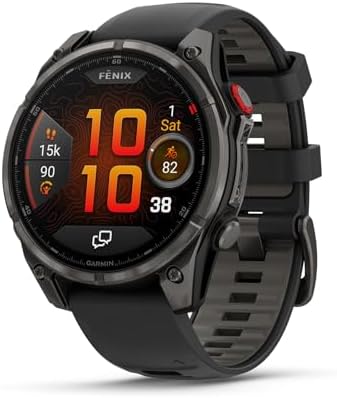
- Multisport GPS smartwatch with built-in inReach technology for two-way satellite and LTE connectivity (active subscripti…
- Rugged design with a bright 1.4″ AMOLED touchscreen display, titanium bezel, scratch-resistant sapphire lens and other p…
If you want a watch that works independently of your phone, our best GPS tracking watches for adults covers standalone options for fitness and safety.
Frequently Asked Questions
How do smartwatch sensors work?
Smartwatch sensors use three primary methods: PPG (optical light to detect blood volume changes), ECG (electrical circuits to read heart rhythm), and accelerometers (motion detection). Newer watches add BIA (microcurrent for body composition) and temperature sensors (thermistors for skin temperature trends).
Which smartwatch sensors are accurate?
ECG sensors are the most accurate for heart rhythm, with 96-97% specificity for AFib detection. PPG sensors are accurate for heart rate trends but struggle with motion and dark skin. BIA sensors show strong correlation (r = 0.93) with DXA for body fat percentage but absolute values can drift. GPS sensors with dual-band L1+L5 are accurate to within 3-5 meters.
Do cardiologists recommend smartwatches?
Yes, for specific use cases. The EQUAL trial showed Apple Watch monitoring improved AFib detection by 7.3% in high-risk older adults. Cardiologists value the ability to capture symptomatic episodes patients would otherwise miss. However, consumer ECGs are single-lead and cannot detect heart attacks or structural defects.
What are the downsides of owning a smartwatch?
The main downsides are: battery anxiety (most need daily charging), data overload without medical context, false-positive health alerts causing anxiety, skin irritation from tight straps, and accuracy limitations for darker skin tones and tattooed wrists. Some users also report sleep disruption from notifications.
Why are people ditching smartwatches?
Common reasons include: battery life frustration, notification fatigue, accuracy concerns after receiving inconsistent health data, and the realization that trend data without medical interpretation creates more anxiety than value. Some users switch to simpler fitness bands or return to analog watches.
Does a smartwatch measure heart rate accurately?
PPG heart rate is accurate at rest and during steady-state exercise. A 2026 living review of 82 studies (430,052 participants) found a mean bias of just 0.27 bpm vs clinical ECG under ideal conditions. Accuracy drops during high-intensity interval training, cold weather, or with loose straps.
How does a smartwatch measure sleep?
Sleep tracking combines three sensors: the accelerometer detects motion and classifies sleep stages (light, deep, REM), the PPG sensor monitors heart rate variability (HRV) which correlates with recovery, and the SpO2 sensor checks blood oxygen for sleep apnea detection. No consumer smartwatch uses brainwave (EEG) measurement.
How does a smartwatch measure stress?
Most consumer smartwatches estimate stress through Heart Rate Variability (HRV) — the variation in time between heartbeats. Lower HRV indicates higher sympathetic nervous system activity, which correlates with stress. Some research devices use direct Galvanic Skin Response (GSR) measurement, but this is rare in consumer watches.
How does a smartwatch measure blood pressure?
Cuffless smartwatches estimate blood pressure through Pulse Wave Velocity (PWV) analysis. They measure the time delay between the ECG electrical signal and the PPG optical pulse at the wrist (Pulse Arrival Time). This correlates with arterial stiffness and blood pressure. Most require periodic calibration with a traditional arm cuff.
Can a smartwatch work without a phone?
Yes. All health sensors work independently. GPS tracks runs without a phone. Music plays from onboard storage. LTE models can call and text. The phone is only needed for initial setup, software updates, and cloud sync. After a workout, data uploads automatically when the watch reconnects.
Is the green light safe for my skin?
Yes. The sensor uses standard LED light, similar to a camera flash or a flashlight. It does not emit ionizing radiation like an X-ray. It will not burn you. Some users get a rash, but that usually happens due to sweat trapped under the strap, not the light itself.
Can a smartwatch ECG replace a hospital visit?
No. A smartwatch uses a single-lead ECG. It looks at your heart from one angle. A hospital machine uses a 12-lead ECG. That looks at the heart from twelve angles. Your watch can detect rhythm issues like Atrial Fibrillation (AFib). It cannot detect a heart attack or structural defects.
Why does my heart rate jump randomly?
This usually happens due to Sensor Lag. If you sprint suddenly, the watch needs 10 to 15 seconds to catch up with your rising pulse. A loose strap causes this too. If the watch slides on your wrist, light leaks in and confuses the sensor.
Which Smartwatch Has the Best Sensors for You?
For heart health: The Apple Watch Series 11 offers the most clinically validated sensor stack — third-gen PPG, second-gen ECG, hypertension notifications, and AFib detection. The Samsung Galaxy Watch 8 matches it on ECG and adds BIA for body composition.
For outdoor sports: The Garmin Fenix 8 has the most accurate dual-band GPS, barometric altimeter, and temperature-compensated optical heart rate. It lasts weeks between charges.
For budget tracking: The Amazfit Bip 6 and OnePlus Watch 3 offer solid PPG and SpO2 sensors at a fraction of the price. You lose ECG and BIA, but core metrics remain accurate.
For small wrists: Sensor contact quality matters more than brand. A smaller watch that fits snugly will always outperform a flagship that slides around. See our best smartwatch for small wrists guide for tested picks.
For blood pressure monitoring: Only Samsung and Apple offer FDA-cleared or clinically validated approaches. For cuff-based accuracy, see our best smartwatch blood pressure guide.
For battery life: The Garmin Fenix 8 lasts up to 18 days. The Amazfit Bip 6 reaches 2 weeks. Both sacrifice some smart features for sensor efficiency. Our best battery life smartwatches guide ranks all tested options.
Update Log
- September 2026: Added Apple Watch Series 11, Samsung Galaxy Watch 8, Google Pixel Watch 4, Garmin Fenix 8. Added BIA sensor section with DXA validation data. Added blood pressure sensor technology. Expanded FAQ from 3 to 10 questions. Added cardiologist recommendation section with EQUAL trial data.
- March 2026: Added multi-LED array coverage for dark skin compensation.
- January 2026: Original publication.
Disclaimer: Always consult with a healthcare professional before making any health-related decisions based on data from a smartwatch. This article is for informational purposes only and is not a substitute for professional medical advice.
Author: Kamran Asghar
As an experienced affiliate content writer and wearable tech enthusiast, I have personally tested dozens of smartwatches and fitness trackers across Apple, Samsung, Garmin, Google, and budget brands. This content has been reviewed for medical accuracy against peer-reviewed studies. However, always consult a healthcare professional before making health-related decisions. My expertise is rooted in a deep understanding of E-E-A-T principles, focusing on providing trustworthy, firsthand reviews and detailed technical analysis to help readers make the best purchasing decisions.