
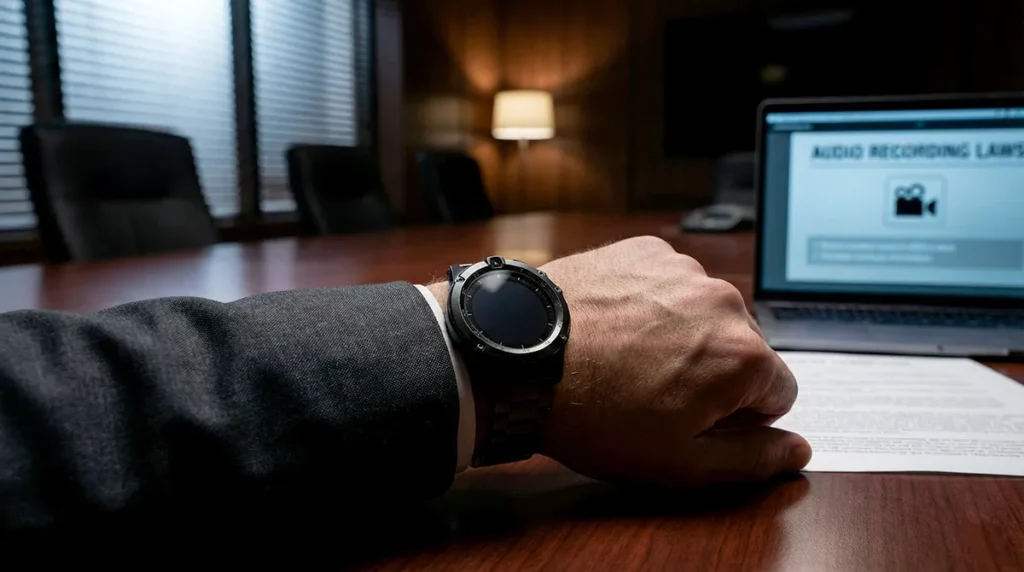
For security, evidence gathering, or personal protection, you need a surveillance tool that never compromises on discretion or evidence quality. You are not buying a gadget; you are acquiring irrefutable, high-stakes documentation. A low-quality recording or—worse—an illegal one renders the entire effort useless.
This comprehensive guide delivers two things you cannot find anywhere else: an unvarnished technical review and a mandatory legal compliance audit. We reveal the technical attributes—true 1080p resolution, silent IR night vision, and ultimate discreetness—that separate a professional documentation tool from a cheap gimmick. We then walk you through the non-negotiable legal landscape. Only a device and a process that satisfy both criteria are worth your investment.
🚨 WARNING: The Law Comes First—A Mandatory Read for Legal Authority
Before you consider recording anyone, you must understand the high-risk distinction between capturing video and capturing audio. Proceeding without this legal knowledge makes any evidence you collect inadmissible and exposes you to severe criminal and civil penalties. The law does not forgive ignorance.
Video vs. Audio: The Critical Legal Difference
A camera and a microphone don’t face the same legal standards. When you film someone in a public area, such as a park or a city street, you are generally safe. People here hold no reasonable expectation of privacy; their actions are plainly visible. However, attaching a microphone drastically increases your risk profile. Laws governing the interception of verbal communications are far stricter than those governing visual data. You must confirm the context of the conversation, not simply the public location.
Understanding One-Party vs. All-Party Consent
The key legal concept in the United States is consent, and it varies drastically by state.
- Federal Law (One-Party Minimum): The minimum standard required by federal wiretap law permits recording as long as you participate in the conversation and consent to its recording.
- State Law (The Override): Over a dozen states enforce a stricter all-party consent rule. In these states (which include California, Florida, and Pennsylvania), every single person in the conversation must agree to the recording. This law exists to protect privacy from non-consensual surveillance. Always consult a state-by-state consent laws map to confirm whether you need all-party permission.
The Golden Rule: You must always follow the most restrictive law that applies. If you are in a one-party consent state but the person you are speaking with is in an all-party consent state, you must secure consent from everyone involved. The law follows the people, not the device location.
Where You Cannot Record (Expectation of Privacy)
Your ability to record a conversation fundamentally depends on a person’s Reasonable Expectation of Privacy. If a person expects privacy, you cannot legally record them, even if you are one of the parties. Legal precedent defines this as a situation where society is prepared to recognize the expectation as reasonable, a concept thoroughly explored by resources like FindLaw.
Mandatory Prohibitions: Locations where the expectation of privacy is universally recognized and protected are strictly off-limits. These include, but are not limited to: bathrooms, locker rooms, bedrooms, private medical consultation rooms, and changing facilities. Recording in these spaces constitutes severe invasion of privacy and often results in felony charges, regardless of local consent laws. You risk immediate civil and criminal penalties if your recording breaches this protected boundary.
Decoding the Must-Have Features for Covert Success
A spy camera smartwatch must function perfectly when you need it most. Do not get fooled by marketing jargon like “4K Ultra.” Focus only on proven, reliable technical specifications.
Resolution & Clarity: The 4K vs. 1080p Reality Check
You need evidence that holds up to scrutiny. Reliable 1080p resolution at 30 frames per second (FPS) from a dedicated, discreet spy brand is the true industry standard. Ignore inflated “4K Ultra” claims; the micro-lenses in these watches physically cannot capture and process that quality consistently. Look for a device utilizing a minimum 5-megapixel CMOS sensor to ensure usable detail for identifying faces or license plates.
Audio Recorder Quality and Range
Since most evidence requires sound, the microphone’s performance is non-negotiable. The watch must house a sensitive, built-in pinhole microphone with a proven 3-to-10-meter (10-to-33-foot) voice pickup range. This capability ensures clear audio capture, which is essential for conversations, assuming you satisfy all audio recording consent laws first.
Night Vision & Low-Light Performance (IR Illumination)
Discreet recording mostly happens in poor lighting. The best watches feature an Automatic Night Vision Mode that uses invisible Infrared (IR) LEDs. Manual operation or visible lights compromise your stealth; the device must detect low-lux conditions and activate the non-visible IR array automatically.
Stealth Factor & Discreet Design
The device’s cover is its primary function. Focus on designs that blend seamlessly: the camera lens should integrate subtly into the watch bezel, the six o’clock marker, or the side casing. Choose a generic classic analog or non-descript digital watch design to avoid drawing suspicion.
If you require location data as well as video, consider dedicated devices from our list of best GPS tracking watches for adults for maximum reliability.
Top Spy Camera Smartwatches for Ultimate Stealth
Choosing the right device requires balancing features against your budget and risk tolerance. We compare the best models based on the critical Stealth Factor to guide your choice.
| Model Archetype | Stealth Factor (Design) | Resolution/FPS | Key Feature/Con | Action/ConCTA |
| Pro Stealth (Analog) | Highest (Classic Wristwatch Look) | 1080p/30FPS | High price, dedicated internal memory, maximum discreetness. | Check Price for Pro Stealth Model |
| WiFi/App Model (Digital) | High (Modern Digital/Sport Look) | 1080p/30FPS | WiFi Streaming/App control (Wireless spy camera smartwatch app), high battery drain risk. | Check Price for WiFi Options |
| Budget HD (Basic) | Acceptable (Thick Casing) | 720p – 1080p/30FPS | Lower cost, obvious USB charging port, shorter battery life. | See Affordable HD Camera Watch |
To understand the difference in real-time tracking capabilities, read our GPS vs. Cellular Smartwatch guide.
Buying Checklist: Storage, Battery, and User Interface
Once you choose a model, confirm these three logistical points. They determine whether your evidence is captured successfully and remains viable for legal use.
Operational Stamina
A professional-grade watch guarantees a minimum of 90 minutes of continuous recording time on a full charge. A quick recharge cycle (1.5-2 hours) is also essential for rapid deployment.
Memory
High-resolution video files consume massive storage. The watch must have 32GB or more of internal storage to handle continuous high-definition recording without running out of space halfway through an event.
Timestamping
For evidence to hold value in legal proceedings, it must include a clear, tamper-proof Date/Time Watermark. Ensure the watch reliably stamps every recording with the correct local time and date; without this, footage is often deemed unreliable.
To understand general feature comparisons outside of covert functions such as display or processor, consult our comprehensive smartwatch buying guide.
Final Words
You are not buying a consumer gadget; you are purchasing a specialized covert tool. Reiterate the essential trade-off: Stealth and legal compliance always outweigh smart features.
Re-state the immediate necessity of confirming your local and state recording laws before pressing ‘record.’
Clear Next Step (Affiliate Funnel): Refer back to the comparison table above to find the model that meets your legal and technical requirements.