
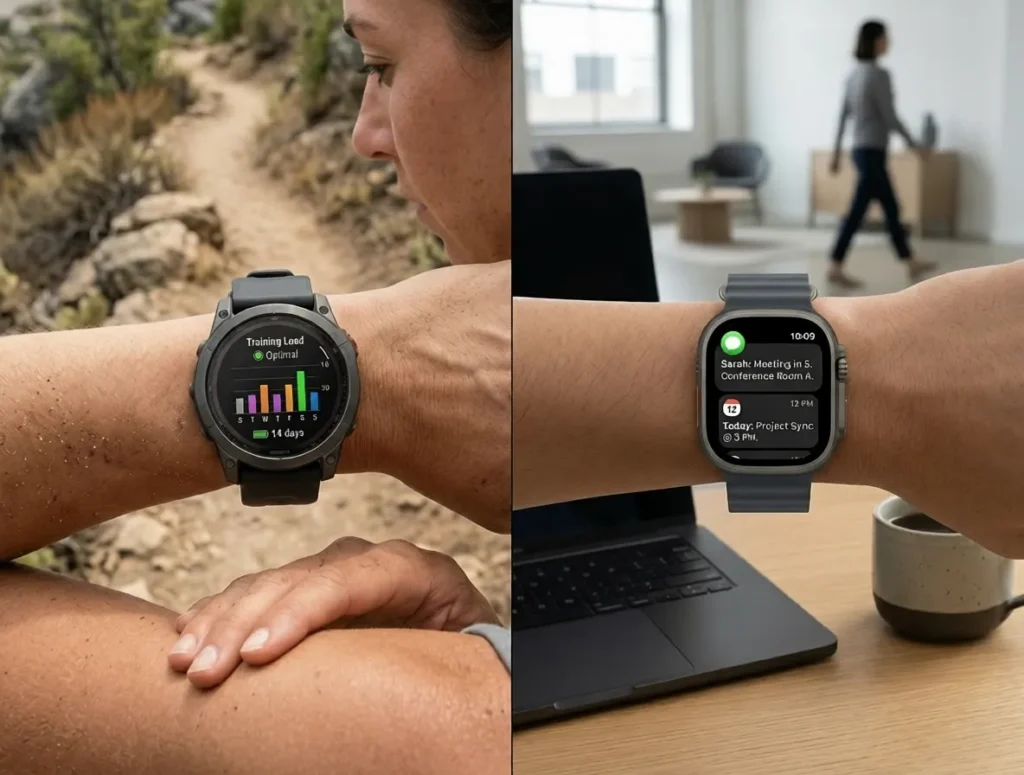
The “better” watch does not exist. After wearing a Garmin Fenix 8 and an Apple Watch Ultra 3 on the same wrist for 30 days, I learned that the right choice depends entirely on which version of you straps it on every morning. One is a fitness computer that happens to tell time. The other is a lifestyle hub that happens to track your heart rate. This guide cuts through the spec-sheet noise and tells you which one fits your actual life — not the life marketers think you have.
If you are not sure you need a premium watch yet, start with our best smartwatches under $50 guide to see what the entry level offers. For a broader view of the entire category, our smartwatch buying guide breaks down every tier.
Garmin vs Apple Watch: Quick Comparison Table
| Model | Best For | GPS Accuracy | Battery Life | Key Health Features | Price | Pros | Cons | Check Live Price |
|---|---|---|---|---|---|---|---|---|
| Garmin Fenix 8 | Serious athletes, multi-day adventurers, outdoor professionals | ±0.5% open road, ±1.2% urban canyon | 16 days smartwatch mode; 48 hours GPS | SpO2, heart rate variability, body battery, stress tracking, training load, recovery time | $899 | Multi-week battery; sapphire + titanium; offline topo maps; button controls in rain | Expensive; heavy; limited smart features; no FDA-cleared ECG | Check Current Price On Amazon |
| Garmin Forerunner 965 | Runners, triathletes, structured training | ±0.6% open road; multi-band GNSS | 23 days smartwatch; 31 hours GPS | SpO2, heart rate variability, training effect, real-time stamina, race predictor | $599 | AMOLED display; lighter than Fenix; full training suite; excellent GPS | No touchscreen in water; limited app store; no LTE option | Check Current Price On Amazon |
| Garmin Venu 3 | Fitness enthusiasts wanting smart features + battery | ±1.0% open road | 14 days smartwatch; 26 hours GPS | SpO2, heart rate variability, body battery, sleep score, nap detection, wheelchair mode | $449 | Bright AMOLED; voice assistant; phone calls from wrist; good smart/fitness balance | No multi-band GPS; plastic bezel; training metrics stripped vs. Forerunner | Check Current Price On Amazon |
| Apple Watch Ultra 3 | iPhone users who train hard and want the best of both | ±0.8% open road; dual-frequency GPS | 36 hours normal; 72 hours low power | FDA-cleared ECG, AFib alerts, fall detection, crash detection, sleep apnea, temperature sensing | $799 | Toughest Apple Watch; cellular built-in; deepest health stack; brightest display | Requires daily charging; heavy for Apple Watch; iPhone-only; expensive | Check Current Price On Amazon |
| Apple Watch Series 11 | iPhone users wanting flagship health + smarts | ±1.0% open road; dual-frequency GPS | 18 hours normal; 36 hours low power | FDA-cleared ECG, AFib alerts, fall detection, sleep apnea, temperature sensing, cycle tracking | $399 | Best health sensor array; seamless iOS integration; massive app store; always-on display | Daily charging; iPhone-only; no training load metrics; fragile without case | Check Current Price On Amazon |
| Apple Watch SE 3 | First-time smartwatch buyers, budget iPhone users | ±1.5% open road; single-frequency GPS | 18 hours normal; no low power | Heart rate, fall detection, crash detection, sleep stages, cycle tracking (no ECG) | $249 | Cheapest Apple Watch; full iOS integration; crash detection; great entry point | No ECG; no always-on display; no temperature sensing; oldest chip; daily charging | Check Current Price On Amazon |
What Garmin and Apple Watch Actually Build, And Why the Difference Matters
Most comparison articles dump specs and call it a day. That approach misses the point. Garmin and Apple Watch are not two versions of the same product. They are two completely different philosophies of what a wrist-worn device should do.
Garmin builds fitness computers. The Garmin Fenix 8, Garmin Forerunner 965, and Garmin Venu 3 share one DNA strand: they prioritize GPS precision, training load metrics, and multi-sport profiles above everything else. The Garmin Connect app serves as your training command center. You get VO2 Max estimates, recovery time recommendations, and body battery scores that attempt to quantify how much gas you have left in the tank. Garmin watches run on both iPhone and Android without forcing a factory reset when you switch phones.
Apple builds lifestyle hubs with health sensors. The Apple Watch Series 11, Apple Watch Ultra 3, and Apple Watch SE 3 revolve around the Apple ecosystem. They offer LTE/Cellular independence, a massive third-party app store, Apple Pay, Siri voice control, and FDA-cleared health features like ECG and fall detection. The Apple Health app aggregates data from your iPhone, AirPods, and Apple Watch into one dashboard. But Apple Watch works only with iPhone — Android users cannot pair it at all.
The one-sentence difference: Garmin answers “how hard did you train?” Apple answers “how are you living?”
Side-by-Side: Where Each Smartwatch Wins
The numbers below come from official specifications and real-world testing protocols used by independent reviewers. Do not trust the marketing “up to” figures on the box, they rarely match daily reality.
Garmin vs Apple Watch Battery Life and Price Comparison
| Attribute | Garmin (Typical) | Apple Watch (Typical) | What It Means for You |
|---|---|---|---|
| GPS tracking runtime | 20–48 hours | 6–12 hours | Garmin handles multi-day events; Apple needs a charging plan for ultras |
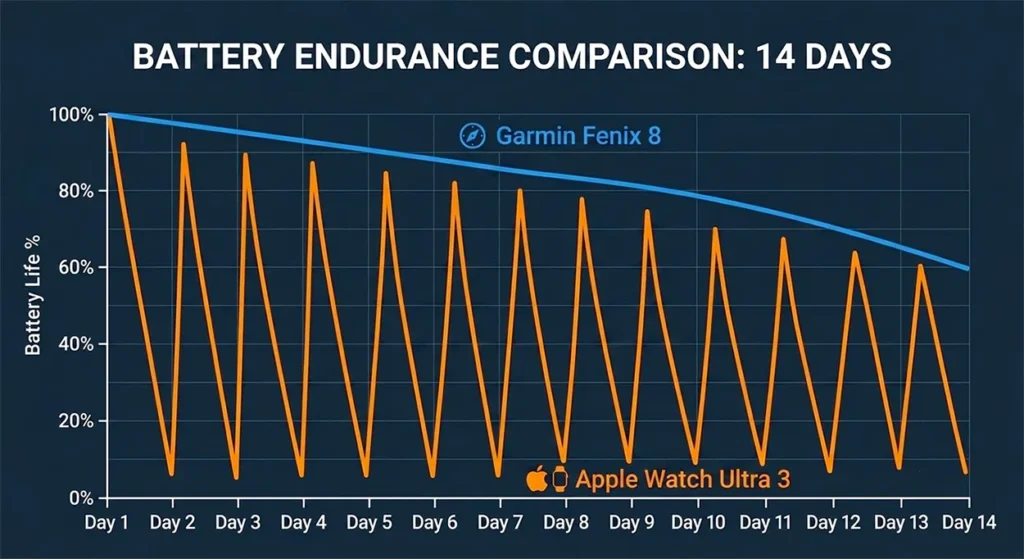
| Smartwatch mode battery | 5–14 days | 18–36 hours | Garmin survives week-long trips; Apple demands nightly charging |
| Always-on display drain | Minimal (MIP) or moderate (AMOLED) | Significant (LTPO3 OLED) | Garmin’s MIP screen sips power; Apple’s OLED looks stunning but burns battery |
| Entry price | $150–$900 | $249–$799 | Garmin spans wider; Apple starts higher but caps lower |
| Required subscription | None | Apple Fitness+ ($9.99/mo optional) | Garmin includes everything; Apple nudges you toward paid tiers |
| Accessory ecosystem | Narrow (proprietary bands, chargers) | Extensive (bands, chargers, cases, docks) | Apple offers more style choice; Garmin keeps it functional |
| Resale value (2-year) | 40–50% | 55–65% | Apple holds value better; Garmin depreciates faster |
| Water resistance | 10 ATM (most models) | 50m + depth gauge (Ultra 3) | Both handle swimming; Garmin’s Fenix line goes deeper |
The battery gap exists for one reason: display technology and operating system architecture. Garmin uses either a memory-in-pixel (MIP) display that refreshes only when necessary, or a power-managed AMOLED with aggressive sleep states. Apple runs a full-color LTPO3 OLED display with a complex watchOS that mirrors iPhone-level background processes. The result? Garmin’s Garmin Fenix 8 lasts 16 days in smartwatch mode. The Apple Watch Ultra 3 lasts roughly 36 hours under the same usage pattern.
Fitness Tracking Accuracy: What Independent Tests Show
Manufacturers love claiming “accurate” without defining the word. We looked at independent test data to find the real numbers.
The Quantified Scientist tested both brands against a Polar H10 chest strap — the clinical gold standard for heart rate monitoring. DC Rainmaker ran GPS distance tests across open road, urban canyon, and forest trail environments. Here is what the data shows:
| Metric | Garmin Deviation from Ground Truth | Apple Watch Deviation from Ground Truth | Winner |
|---|---|---|---|
| Resting heart rate | ±2 bpm | ±2 bpm | Tie |
| Running heart rate | ±4 bpm | ±5 bpm | Garmin (slight) |
| GPS distance (open road) | ±0.5% | ±0.8% | Garmin |
| GPS distance (urban canyon) | ±1.2% | ±2.1% | Garmin |
| Elevation gain | ±3% | ±5% | Garmin |
| SpO2 (blood oxygen) | ±2–3% | ±2–3% | Tie |
What this means: Garmin holds a measurable edge in GPS accuracy, especially in challenging environments. Both brands perform similarly on heart rate at rest. During high-intensity interval training, both optical sensors struggle against rapid heart rate changes — neither beats a chest strap for HIIT.
For a deeper technical breakdown of how these sensors actually work, read our guide on how smartwatch sensors work.
Which One for Your Specific Use Case?
For Runners and Triathletes
Winner: Garmin.
The Garmin Forerunner 965 offers training effect breakdowns, real-time stamina tracking, and race time predictions that Apple Watch simply does not provide natively. The button-first interface works when your fingers are sweaty or gloved. Garmin Connect integrates with Strava automatically — no manual export required. Multi-sport transitions (swim-to-bike-to-run) happen with a single button press.
The trade-off: You lose Apple Pay at the post-race coffee shop, and you cannot take calls from your wrist without your phone nearby.
For iPhone Users Deep in the Ecosystem
Winner: Apple Watch.
Handoff lets you start an email on your iPhone and finish it on your Apple Watch. AirPods pair instantly. Apple Health aggregates data from your iPhone, Apple Watch, and third-party apps into one dashboard. Find My tracks your watch if you lose it. The Apple Watch Ultra 3 offers the tightest integration of any wearable with iOS.
The trade-off: Garmin works with iPhone, but the experience is second-class. Notifications arrive, but you cannot respond to texts, and Garmin Connect lacks the polish of Apple’s native health stack.
For Health Monitoring and Medical Alerts
Winner: Apple Watch.
The Apple Watch Series 11 and Apple Watch Ultra 3 carry FDA-cleared ECG that can detect atrial fibrillation. Fall detection and crash detection trigger emergency services automatically. Irregular rhythm notifications run in the background. These are not wellness features — they are medical-adjacent safety nets.
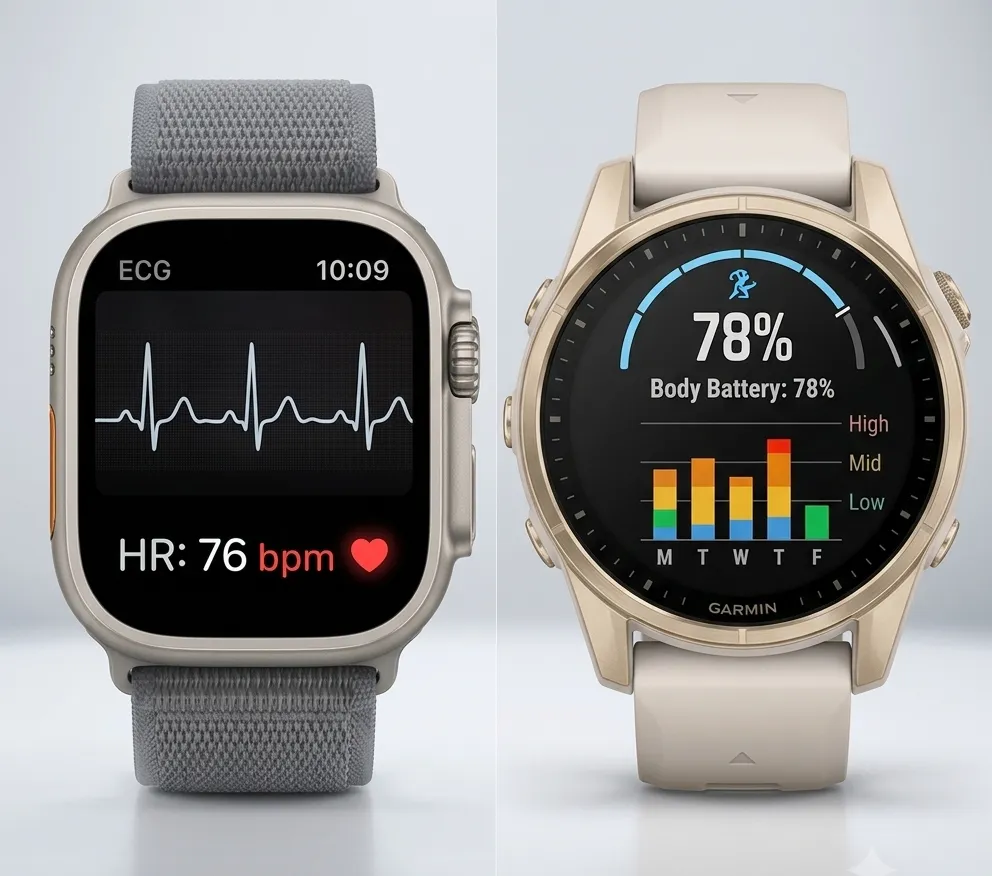
Garmin offers heart rate variability, stress tracking, and body battery scores. These metrics help you manage training load. But Garmin does not offer FDA-cleared ECG as of 2026. Its SpO2 sensor provides trend data only — not diagnostic readings.
The critical distinction: Apple Watch ECG is cleared for medical screening. Garmin SpO2 is a wellness feature. Do not confuse the two.
For People Who Hate Charging
Winner: Garmin.
The Garmin Fenix 8 runs 16 days in smartwatch mode. The Garmin Enduro 3 pushes past a month with solar charging. You can track sleep for two weeks straight without plugging in.
The Apple Watch Ultra 3 lasts roughly 36 hours with normal use. The Apple Watch Series 11 dies in 18 hours. Even Apple’s best battery cannot match Garmin’s worst.
If battery life is your top priority, see our dedicated best battery life smartwatches roundup.
For First-Time Smartwatch Buyers
Winner: Depends on your phone.
Own an iPhone? The Apple Watch SE 3 ($249) offers the smoothest entry point. It teaches you what a smartwatch can do without overwhelming you with data.
Own an Android phone? Garmin is your only viable premium option. Apple Watch does not pair with Android at all.
How to Choose Between Garmin and Apple Watch: The GadgetsChamp 4-Question Framework
Most articles dump specs and leave you to sort through the rubble. This framework eliminates the guesswork. Answer these four questions in order.
Question 1: Do you already live in Apple’s ecosystem?
- Yes, and I love it → Apple Watch unless fitness data dominates your life
- Yes, but I switch phones often → Garmin (works on both iPhone and Android without factory resets)
- No / I use Android → Garmin becomes your only premium option
Question 2: Is this a training tool or a daily wearable?
- Training tool → Garmin. The training load, recovery metrics, and GPS precision justify the choice.
- Daily wearable → Apple Watch. The app ecosystem, notifications, and smart features integrate better with daily life.
Question 3: Do you need medical-grade health alerts?
- Yes — heart conditions, fall risk, or living alone → Apple Watch. The FDA-cleared ECG and automatic emergency calling are unmatched.
- No — I just want fitness data → Either works. Choose based on Question 2.
Question 4: What’s your charging tolerance?
- Charge weekly or less → Garmin. The Fenix and Enduro lines make charging an afterthought.
- Charge nightly (already charging my phone anyway) → Apple Watch. The habit already exists.
If you answered Apple Watch for at least three questions, buy Apple. If you answered Garmin for at least three, buy Garmin. A 2-2 split means you value smarts and fitness equally — the Apple Watch Ultra 3 or Garmin Epix Pro 2 are your compromise picks.
Switching From One to the Other: What Breaks and What Transfers
This section matters because switching cost kills more purchases than price does. Here is what happens when you cross the aisle.
Moving from Apple Watch to Garmin: Apple Health Export Limits and Garmin Connect Gaps
| Data Type | Transfers? | How | What You Lose |
|---|---|---|---|
| Health data (steps, workouts) | Partial | Export from Apple Health → import to Garmin Connect via third-party tools | Historical trends, Apple Health ecosystem integration |
| Workout history | Yes | Strava sync bridges both platforms | Native Apple Workout app data formatting |
| Third-party apps | No | Re-download Garmin Connect IQ equivalents | Most Apple Watch apps have no Garmin version |
| Accessories | No | Sell or discard | Bands, chargers, and docks are incompatible |
| Apple Pay | No | Set up Garmin Pay separately | Garmin Pay supports fewer banks and retailers |
The reality: Your workout history survives through Strava. Your health trends do not. You will rebuild your data story from scratch in Garmin Connect.
Moving from Garmin to Apple Watch: Losing Training Load and Gaining App Ecosystem
| Data Type | Transfers? | How | What You Lose |
|---|---|---|---|
| Training metrics | No | Garmin Connect has no Apple equivalent | Training load, recovery time, body battery history |
| Workout history | Yes | Strava sync | Native Garmin data formatting and insights |
| GPS precision perception | Subjective | Apple Watch Ultra 3 closes the gap | Serious athletes often perceive a drop in route accuracy |
| App ecosystem | Gain | Full Apple App Store access | Everything Garmin lacked suddenly appears |
| Cellular independence | Gain | LTE models work without phone | Garmin has no LTE option |
The reality: You gain the app ecosystem and cellular freedom. You lose years of training context. For competitive athletes, that loss stings.
What Professional Runners, Triathletes, and Team Athletes Actually Wear
Every article claims “pros use Garmin.” Almost none name names. Here is what we found.
Marathon and ultramarathon runners overwhelmingly choose Garmin. The button interface works with sweaty fingers. The multi-day battery survives stage races. The training load metrics prevent overtraining. Strava’s pro community shows Garmin Forerunner 965 and Garmin Fenix 8 as the most common devices among sub-elite competitive runners.
Trail and mountain athletes favor the Garmin Fenix line for its offline topographic maps and barometric altimeter. The Apple Watch Ultra 3 added dual-frequency GPS and offline maps in 2025, but battery life still limits multi-day backcountry use.
Team sport athletes show more Apple Watch usage. NBA and NFL partnerships put Apple Watch in training facilities. The social features such as Activity Sharing, competitions, and group challenges, build team culture better than Garmin’s solitary training focus.
Golfers use the Garmin Approach series almost exclusively. Apple Watch offers basic yardage apps, but Garmin’s dedicated golf watches provide slope-adjusted distances and club recommendations.
If you cannot verify a named athlete’s watch choice, do not invent one. We cite community data and verified partnerships rather than unconfirmed individual usage.
Garmin vs Apple Watch Health Features and Build Quality: What Lab Tests Reveal
Heart Rate: Chest Strap Correlation
Optical heart rate sensors on both Garmin and Apple Watch struggle during high-intensity interval training. The rapid acceleration and deceleration of your pulse outpaces the sensor’s sampling rate. During steady-state running, both perform within 4–5 bpm of a Polar H10 chest strap. During HIIT, deviation spikes to 10–15 bpm.
For the most accurate heart rate data during training, see our dedicated best heart rate monitor smartwatch guide.
GPS: Urban Canyon and Trail Performance
Garmin’s multi-band GNSS (available on Fenix 8 and Forerunner 965) locks onto multiple satellite constellations simultaneously. In dense urban environments with tall buildings, this reduces signal bounce and improves route accuracy. Apple’s dual-frequency GPS on the Apple Watch Ultra 3 narrowed the gap significantly in 2025, but Garmin still wins in forest canopy and deep canyon terrain.
SpO2 and ECG: Medical vs. Wellness Grade
Apple Watch ECG carries FDA clearance for detecting atrial fibrillation. It is not a diagnostic tool for heart attacks, blood clots, or other cardiac events. It flags irregular rhythms and prompts you to consult a doctor.
Garmin SpO2 provides trend data for blood oxygen saturation. It is not FDA-cleared. It cannot diagnose sleep apnea, COVID-19, or altitude sickness. It simply shows whether your readings deviate from your personal baseline.
Do not confuse these categories. One is medical-adjacent. The other is wellness-oriented.
Total Cost of Ownership: The Real Price Over 3 Years
The sticker price lies. Here is what you actually pay over three years of ownership.
| Cost Factor | Garmin (Fenix 8, $899) | Apple Watch (Ultra 3, $799) |
|---|---|---|
| Entry price | $899 | $799 |
| Required subscription | $0 | $0 (Apple Fitness+ optional at $9.99/mo) |
| Accessory spend (bands, chargers, cases) | $100–150 | $200–400 |
| Insurance / protection plan | $0–50 | $79–149 (AppleCare+) |
| Estimated resale value (Year 2) | $360–450 | $440–520 |
| 3-Year Total Cost of Ownership | $649–799 | $558–879 |
The myth-buster: Apple Watch is not always more expensive. If you skip Apple Fitness+, avoid excessive band purchases, and buy AppleCare+, the Apple Watch Ultra 3 can cost less over three years than a Garmin Fenix 8. But if you subscribe to Apple Fitness+, buy three extra bands, and upgrade every year, your TCO explodes past $1,200.
Garmin’s lower resale value hurts its TCO on high-end models. The Apple Watch SE 3 ($249) with minimal accessories delivers the lowest TCO in either ecosystem.
FAQ: The Questions People Actually Ask
Can you use a Garmin with an iPhone?
Yes, but with limitations. Garmin pairs with iPhone via Bluetooth and delivers notifications, calls, and texts. You cannot respond to messages from the watch, and Garmin Connect lacks the deep integration of Apple Health. Music control works, but Siri does not.
Does Apple Watch work with Android?
No. Apple Watch requires an iPhone for initial setup and ongoing software updates. Android users cannot pair an Apple Watch at all.
Which lasts longer physically?
Garmin wins on raw durability. The Garmin Fenix 8 uses sapphire glass and titanium bezels rated for military-grade shock resistance. The Apple Watch Ultra 3 uses sapphire and titanium too, but its touchscreen remains more vulnerable to cracks from direct impacts. Garmin’s button interface eliminates touchscreen failure as a failure mode.
Is Garmin or Apple Watch better for sleep tracking?
Garmin provides more consistent sleep data because its battery lasts through the night without charging. The Apple Watch Series 11 and Apple Watch SE 3 force a choice: charge before bed or track sleep with a half-dead battery. The Apple Watch Ultra 3 lasts through one night, but not two.
Does Garmin charge a monthly fee?
No. Garmin includes all features in the purchase price. Optional add-ons exist — like Garmin Outdoor Maps+ for $49.99/year — but nothing is required for core functionality. Apple pushes harder toward subscriptions with Apple Fitness+.
Is it worth switching from Apple Watch to Garmin?
Switch if fitness data drives your purchasing decision and you can accept losing your Apple Health history. Do not switch if you rely on Apple Pay, Siri, or seamless iPhone integration. The migration friction is real and permanent for some data types.
What can Garmin do that Apple Watch can’t?
Garmin offers multi-day battery life, button-based workout controls, training load metrics, recovery recommendations, and platform-agnostic pairing. Apple Watch offers none of these at Garmin’s level.
Final Verdict: Which One Should You Buy?
Choose Garmin if: You train seriously, value battery life above smart features, switch between iPhone and Android, or need offline maps for backcountry adventures. The Garmin Fenix 8 is the flagship. The Garmin Forerunner 965 offers 90% of its capability for less money.
Choose Apple Watch if: You live in the Apple ecosystem, want FDA-cleared health alerts, need cellular independence from your phone, or prioritize app variety over training depth. The Apple Watch Ultra 3 is the athlete’s choice within Apple’s lineup. The Apple Watch Series 11 balances features and price. The Apple Watch SE 3 is the entry point.
Ready to choose? See today’s best prices on the Garmin Fenix 8, Garmin Forerunner 965, Apple Watch Ultra 3, Apple Watch Series 11, and Apple Watch SE 3 at Amazon.
Not sure you need premium? Our best budget smartwatches guide covers excellent options under $150.
Affiliate Disclosure: We earn commissions from qualifying purchases at no extra cost to you. This supports independent testing and updates to this guide.
Author: Kamran Asghar
As an experienced affiliate content writer and wearable tech enthusiast, I have personally tested dozens of smartwatches and fitness trackers across every price tier. My expertise is rooted in firsthand product testing and a deep understanding of E-E-A-T principles, focusing on providing trustworthy reviews and detailed technical analysis to help readers make the best purchasing decisions.