
Most smartwatch users wear their device 24 hours a day without questioning the flashing lights underneath the case. Those lights and metal contacts act as the engine for your health data. They transform complex biological signals from your wrist into digital numbers on your screen.
To understand why your heart rate reading might jump during a workout or why your doctor trusts some data more than others, you must understand the two primary technologies at play. Smartwatches utilize Photoplethysmography (PPG) for continuous tracking and Electrocardiography (ECG) for medical-grade spot checks. Each method sees your heart differently. One uses light to watch blood flow. The other uses electricity to read heart rhythm.
We tested these sensors extensively in our review of the best budget smartwatches of 2026.
The PPG Sensor: How Your Watch Sees Your Pulse
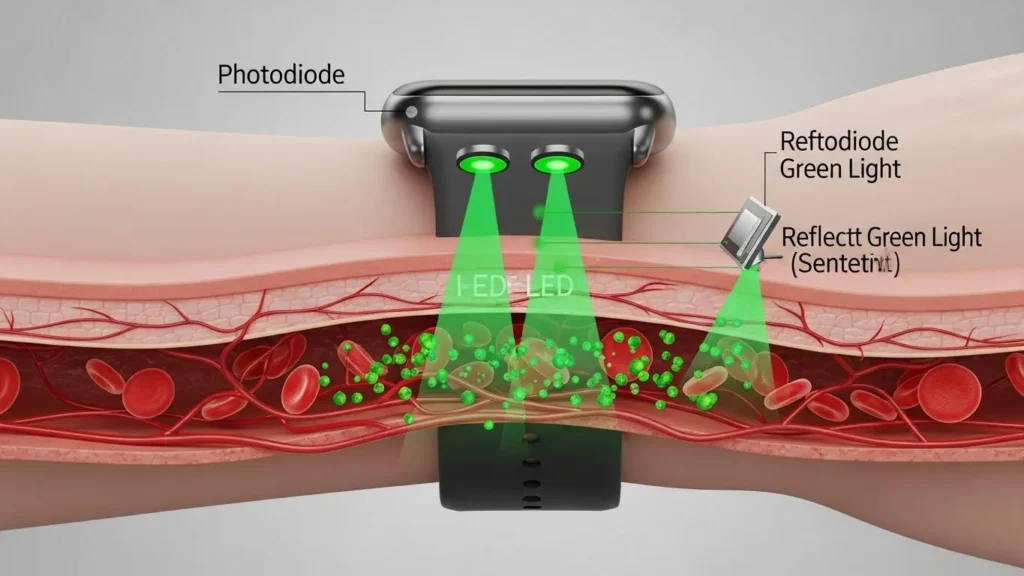
The most common sensor on any budget or premium wearable relies on optical technology. Manufacturers call this the PPG sensor. This component typically consists of two main parts: a light emitter (LED) and a light receiver (photodiode).
Why the Light is Green
Blood is red because it reflects red light and absorbs green light. PPG sensors take advantage of this physical property. The green LEDs on the back of your watch flash hundreds of times per second. When your heart beats, blood flow to your wrist increases. This higher volume of red blood absorbs more green light. Between beats, blood flow decreases, and absorption drops.
The photodiode measures the changing intensity of the light reflecting back from your skin. The watch’s processor analyzes these light variations to calculate your Beats Per Minute (BPM).
Continuous 24/7 Tracking
Since optical sensors require no action from the user, they handle the heavy lifting for daily metrics. PPG sensors track your resting heart rate, sleep stages, and calorie burn. They function best when blood flows smoothly near the skin surface. However, this method faces challenges during intense motion or in cold weather when blood vessels shrink away from the sensor.
The ECG Sensor: Reading Your Heart’s Electrical Signals
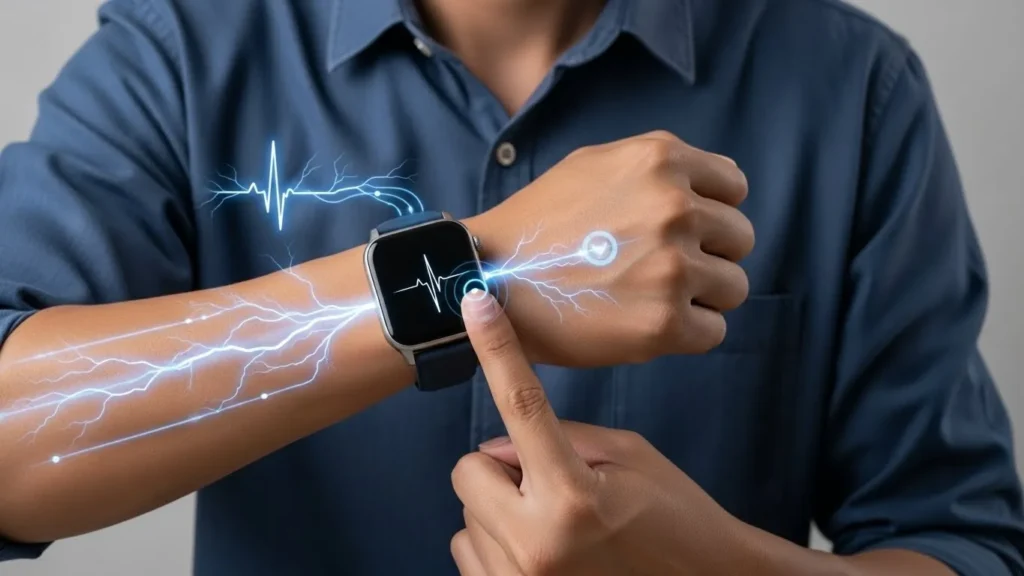
While PPG estimates heart rate through blood flow, an ECG (Electrocardiogram) measures the electrical timing of the heart itself. This sensor technology mimics the machines found in hospitals but uses a simplified single-lead circuit.
Creating the Circuit
An ECG sensor does not use light. It requires a closed electrical loop to function. This is why you must place a finger from your opposite hand on the watch crown or a specific metal contact point. This action completes a circuit across your chest, allowing the sensor to detect the tiny electrical impulses that tell your heart to beat. The American Heart Association notes that wearable ECGs can help detect atrial fibrillation early.
The Medical Standard for Rhythm
The main advantage of ECG over PPG is precision in timing. It captures the specific electrical spike (R-Peak) of every heartbeat. This clarity allows the sensor to detect Atrial Fibrillation (AFib), a common form of irregular heart rhythm. Doctors prefer this data because it shows the electrical pattern rather than just the pulse rate. Unlike the optical sensor, an ECG cannot run automatically in the background. It provides a snapshot of your heart health only when you actively take a reading.
PPG vs. ECG: Which Sensor Should You Trust?
These two technologies serve different purposes. You cannot rely on them for the same tasks.
PPG (Optical) is for Trends: The optical sensor excels at tracking data over long periods. It captures your heart rate while you sleep, walk, or work. The data creates a baseline. This helps you spot changes in your resting heart rate over weeks or months. It works automatically. You do not need to think about it.
ECG (Electrical) is for Precision: The electrical sensor acts as a spot-check tool. You use it when you feel something is wrong. If you feel a palpitation or a skipped beat, the ECG provides a medical-grade look at your heart rhythm. It offers a clear picture that a doctor can actually use. It does not track you all day.
Optical (PPG) vs. Electrical (ECG)
| Feature | Optical Sensor (PPG) | Electrical Sensor (ECG) |
| Technology | Light absorption (Green LEDs) | Electrical circuit (Metal contacts) |
| Best Used For | 24/7 tracking, Sleep, Workouts | Spot-checks for heart irregularities |
| Primary Weakness | Struggles with dark skin & tattoos | Cannot track continuously |
| Data Output | Beats Per Minute (BPM) | Heart Rhythm Waveform |
| Battery Drain | Low (runs in background) | High (runs only on demand) |
Why Your Readings Might Be Wrong
Even the best sensors fail under poor conditions. Real-world factors usually block the signal.
The “Motion Artifact” Problem Optical sensors watch for tiny changes in color. Rhythmic arm movements confuse the sensor. Running or rowing creates “noise” in the data. The watch struggles to separate your pulse from the movement of your arm.
Skin Tone and Tattoos Darker skin contains more melanin. Melanin absorbs green light. This reduces the amount of light reflecting back to the sensor. Tattoos pose a bigger challenge. The ink acts as a barrier. It blocks the light from reaching the blood vessels. Users with wrist tattoos often see gaps in their data. Scientific studies confirm that ink pigment can obstruct the light path, leading to data errors.
The Fit Matters A loose strap ruins the reading. If the sensor pulls away from the skin, sunlight leaks in. This ambient light overwhelms the green LED. The sensor cannot read your blood flow through the glare. A snug fit prevents this error.
Cheap devices usually struggle here. See our list of top smartwatches under $50 for models that passed our stress test.
Beyond the Heart: SpO2 and Motion Sensors
Modern watches use more than just green lights. They combine multiple data points to improve accuracy.
Red Light for Blood Oxygen (SpO2) Green light does not penetrate deep enough to measure oxygen levels. Manufacturers use red and infrared LEDs for this. These wavelengths travel deeper into the tissue. Oxygen-rich blood absorbs infrared light differently than oxygen-poor blood. The watch calculates this difference to show your SpO2 percentage.
The Accelerometer Assist Your watch knows when you are moving. A component called an accelerometer tracks motion. The processor uses this motion data to clean up the heart rate signal. If the accelerometer senses rhythmic stepping, the watch ignores signal noise that matches that rhythm. This helps the sensor focus on the actual heartbeat.
If you need a device specifically for health metrics, check out our guide on best smartwatches for seniors.
FAQ: Quick Answers for Smartwatch Users
Is the green light safe for my skin?
Yes. The sensor uses standard LED light, similar to a camera flash or a flashlight. It does not emit ionizing radiation like an X-ray. It will not burn you. Some users get a rash, but that usually happens due to sweat trapped under the strap, not the light itself.
Can a smartwatch ECG replace a hospital visit?
No. A smartwatch uses a single-lead ECG. It looks at your heart from one angle. A hospital machine uses a 12-lead ECG. That looks at the heart from twelve angles. Your watch can detect rhythm issues like Atrial Fibrillation (AFib). It cannot detect a heart attack or structural defects.
Why does my heart rate jump randomly?
This usually happens due to Sensor Lag. If you sprint suddenly, the watch needs 10 to 15 seconds to catch up with your rising pulse. A loose strap causes this too. If the watch slides on your wrist, light leaks in and confuses the sensor.