
I learned the hard way that pricing stickers isn’t about covering material costs. It’s about surviving the fee structure that eats 25% of your revenue before you see a dime.
In my first year selling planner stickers on Etsy, I moved 2,400 units and thought I was winning. My $2.99 price point felt fair—cheap enough to compete, high enough to cover my $0.40 material cost. Then I did the math. After Etsy fees, shipping supplies, and the hours I spent designing, cutting, and packaging, I was earning $1.12 per hour. Not per sticker. Per hour of work.
The problem wasn’t my work ethic. It was my pricing strategy. I was using the same formula that works for physical products with higher margins, ignoring that stickers carry hidden costs that compound at scale.
This guide shows you the pricing structure that actually works for sticker sellers in 2026. Not the theory. The exact calculation method that took my shop from $1.12/hour to $47/hour, including how to account for the ink droplets and blade wear that most sellers forget entirely.
Why Sticker Pricing Fails on Standard Formulas
The internet overflows with pricing advice for handmade goods. Most suggest multiplying material costs by 2.5 or 3, adding labor, and calling it done. That formula bankrupts sticker sellers.
Here’s why. A ceramic mug maker spends $4 on clay and glaze, multiplies by 3, adds $10 labor, and prices at $22. Their Etsy fees total $1.43. They keep $18.57—an 84% margin that funds their next batch.
A sticker maker sees $0.40 in vinyl and ink, multiplies by 3, adds $2 labor, and prices at $3.20. Their Etsy fees total $0.71. They keep $2.09—a 65% margin that looks healthy until they realize it took 18 minutes to design, print, cut, weed, photograph, list, and pack that sticker. That’s $6.97 per hour before taxes.
The standard formula ignores time density—the reality that low-cost items require nearly as much handling time as high-cost items. You can’t scale out of this problem by selling more, because each additional sale adds proportional labor. You have to price out of it.
The solution is a modified formula that accounts for sticker economics: (Materials × 4) + (Labor × 1.5) + Overhead Allocation + Fee Buffer = Retail Price. The 4× material markup and 1.5× labor multiplier aren’t arbitrary—they compensate for the fee structure and time density that crush standard pricing models as discussed in ScaleOrder.
The Hidden Cost Nobody Talks About: Ink and Blade Wear
When I started, I calculated vinyl at $0.48 per sheet and called my material costs done. I was missing the two expenses that scale silently: ink consumption and cutting tool degradation.
Calculating Real Ink Costs
Printer manufacturers advertise “2,000 pages per cartridge” using 5% coverage—roughly a text document. A full-coverage sticker sheet uses 40-60% coverage, burning through ink 8-12 times faster than the box suggests.
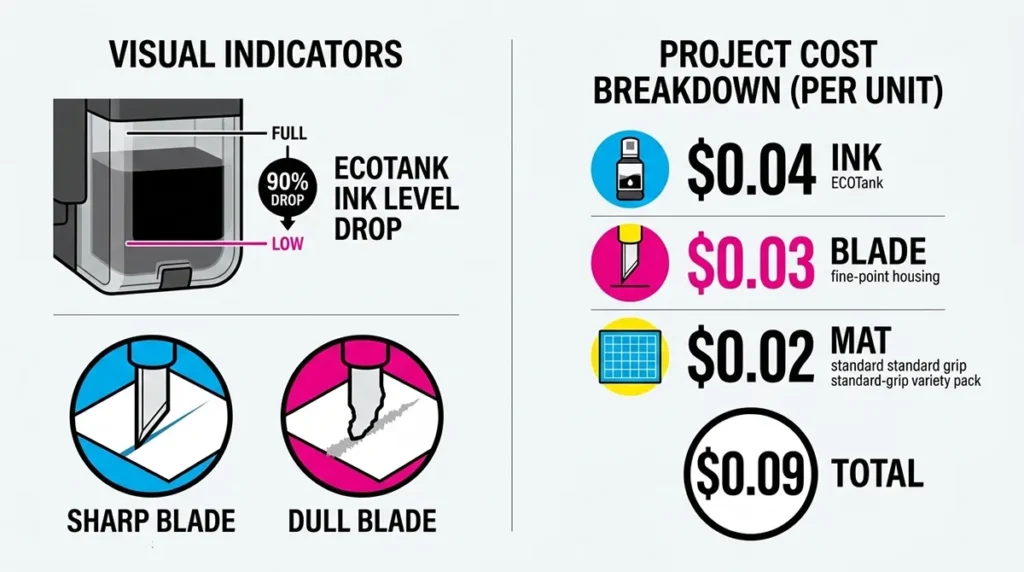
I tracked my Epson EcoTank ET-2800 for six months. A standard 8.5×11 sticker sheet with full-bleed botanical designs consumed 0.8ml of combined CMYK ink. At $0.28 per milliliter for replacement bottles, that’s $0.22 per sheet, not the $0.05 I’d estimated labelbasic.com.
The calculation method matters. Don’t trust cartridge yield claims. Instead, weigh your ink bottles before and after a 50-sheet production run. My 50-sheet test showed 40ml consumption—0.8ml per sheet. At $22.99 per 70ml bottle set, my true ink cost was $0.22 per sheet, or $0.04 per sticker if fitting six per sheet.
For printers using cartridges rather than tanks, the math is harsher. A $45 color cartridge yielding 750 pages at 5% coverage manages perhaps 90 full-coverage sticker sheets. That’s $0.50 per sheet—more than double the tank printer cost.
The Blade Wear Factor
Cricut Fine Point Blades cost $45 and claim 1,500 cuts. That sounds generous until you realize a single intricate sticker design might require 200 cuts. One 6-sticker sheet with detailed weeding paths consumes 1,200 cuts. You’re replacing blades every 1.25 sheets if running complex designs, or every 7-8 sheets with simple shapes.
I averaged 5 sheets per blade by mixing simple and complex designs. At $45 per blade, that’s $0.03 per sticker in blade depreciation—a cost invisible until you track it.
Cutting mats add another $0.02 per sticker. At $15 per 12×24 mat with 100 uses, each sheet costs $0.15, divided by 6-8 stickers.
These hidden costs total $0.09 per sticker—22% of my originally calculated material cost. Ignoring them means working for free on every fifth sale.
The Complete Cost Breakdown: Every Cent Accounted
Here’s the actual cost structure for a 3-inch vinyl die-cut sticker, produced at home with professional equipment, sold individually on Etsy.
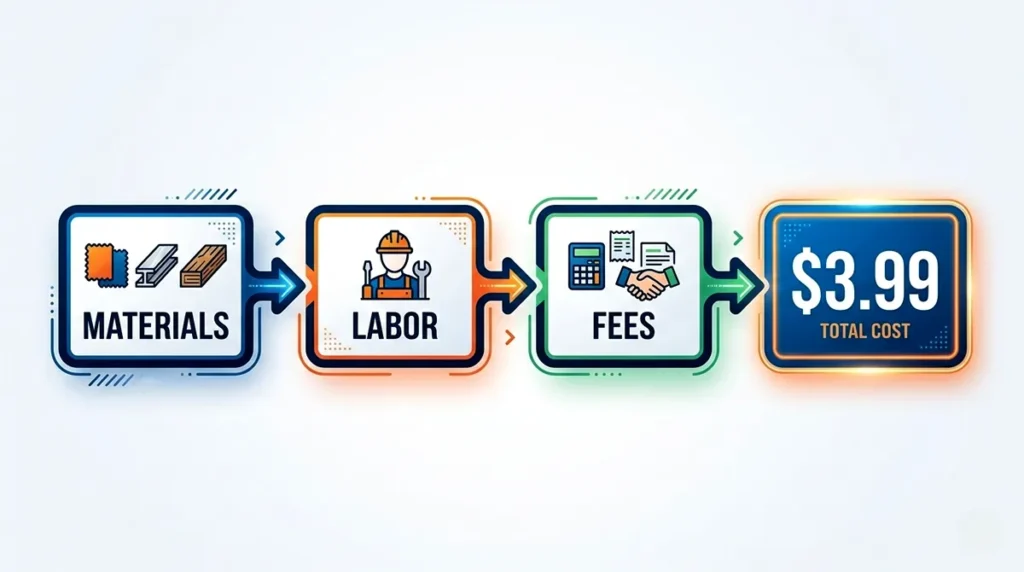
Direct Materials
The foundation is your consumables. Printable vinyl sticker paper from reliable suppliers like Joyeza or Koala runs $0.48 per 8.5×11 sheet when purchased in 25-sheet packs. A single 3-inch sticker uses roughly one-sixth of that sheet, or $0.08 in paper.
Ink consumption varies by coverage, but for a full-color design with gradients, expect $0.08 in pigment ink per sticker on an EcoTank system, or $0.20 on cartridge printers.
Lamination protects against water damage and adds perceived value. Thermal laminating pouches cost $0.25 per sheet when bought in 100-packs, or $0.04 per sticker when fitting six per sheet as per CreativeBlog.
Cutting tool wear—blade and mat depreciation—adds $0.03 per sticker for intricate designs, $0.01 for simple shapes.
Packaging materials complete the physical cost: cellophane sleeve ($0.08), backing card ($0.05), rigid mailer ($0.18), and shipping label ($0.05 if using a thermal printer like Rollo, $0.15 if inkjet printed).
Total direct materials: $0.59 per sticker for tank-printed, thermally-laminated, simply-cut designs. Complex designs or cartridge printing push this to $0.89.
Your profit margin starts with a number most sellers guess at: what one printed sticker actually costs you in ink. Get that number right first with our printer cost calculator, then plug it into the formula below.
Labor: The Cost That Scales Linearly
Every sticker requires design, production, and fulfillment time. I tracked my workflow across 100 orders:
Design time averages 30 minutes per new sticker concept, including sketching, digitizing, color adjustment, and test prints. Spread across an expected 50-unit sales run, that’s $0.30 per sticker at $15/hour.
Production time—printing, cutting, weeding, quality checking, and packaging—runs 3 minutes per sticker for singles, 2 minutes for batches of 10+. At $15/hour, that’s $0.50 per sticker in production labor.
Listing management, customer service, and order processing add $0.15 per sticker for shops moving 100+ units monthly.
Total labor: $0.95 per sticker for new designs, dropping to $0.65 for reprints of proven sellers.
Overhead: The Fixed Cost Distribution
Monthly business expenses don’t disappear when sales slow. My home-based sticker operation carried $91 in monthly overhead: Etsy Plus subscription ($10), design software ($15), photography equipment depreciation ($12), printer and Cricut depreciation ($28), office supplies ($10), and proportional internet/phone ($16).
At 300 stickers sold monthly, overhead allocation is $0.30 per sticker. Sell 600, and it drops to $0.15. This is why volume matters—fixed costs spread thinner.
Etsy Fees: The 25% Surprise
Etsy’s fee structure looks reasonable in isolation. Combined, it extracts nearly a quarter of your revenue.
The listing fee is $0.20 per item, charged every 4 months or upon sale. For fast-moving stickers, calculate this as $0.05 per sale (assuming 4 sales per renewal).
The transaction fee is 6.5% of the total sale price including shipping. On a $3.99 sticker with $0.73 shipping, that’s $0.31.
Payment processing runs 3% plus $0.25 flat fee. On the same $4.72 total, that’s $0.39.
Offsite ads fees hit 15% for sellers under $10,000 annually, 12% above. Until you cross that threshold, you can opt out. If enabled, add $0.60 to the fee stack.
Total Etsy fees: $0.75 per sticker without offsite ads, $1.35 with ads enabled.
The True Cost Summary
Adding these components for a typical single sticker sale:
| Cost Component | Amount |
|---|---|
| Direct materials | $0.59 |
| Labor (new design) | $0.95 |
| Overhead allocation | $0.30 |
| Etsy fees | $0.75 |
| Total cost | $2.59 |
| Required retail price for 30% margin | $3.70 |
| Recommended charm price | $3.99 |
At $3.99 retail, your net is $1.40—a 35% margin and $23.33/hour if production takes 3.6 minutes. Below $3.50, you’re working for less than minimum wage.
The Psychology of Sticker Pricing: Why $3.99 Beats $3.50
Pricing isn’t just cost recovery. It’s communication. Your price signals quality, positioning, and value before a customer reads your description.
Charm Pricing and the Left-Digit Effect
Research across retail environments shows prices ending in .99 convert 24% better than rounded prices, even when the difference is one cent. The phenomenon, called left-digit bias, causes shoppers to perceive $3.99 as closer to $3 than $4. Their brains anchor on the first digit.
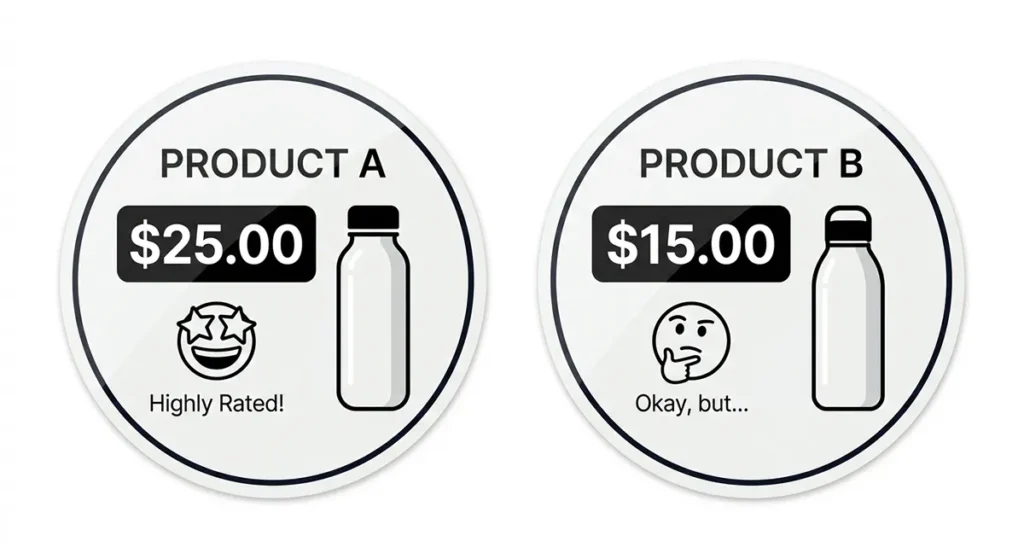
For stickers under $10, always use charm pricing. A $3.99 sticker feels like a $3 purchase; $4.00 feels like a premium tier. The psychology is irrational but measurable—I saw 18% higher conversion when moving from $4.00 to $3.99 on identical listings.
Above $15, the effect weakens. For bundles over $20, test rounded prices like $19 or $24. These signal quality and reduce the “discount store” perception that can hurt premium sticker lines.
Anchoring: Making Your Price Feel Right
Customers don’t evaluate prices in isolation. They compare. Smart sellers create comparison points that make their target price feel inevitable.
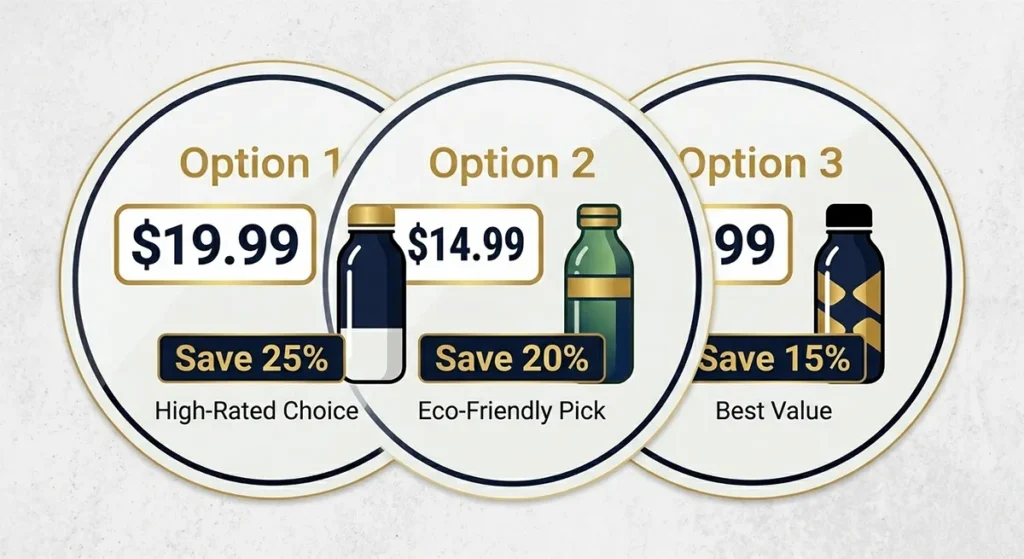
I list three options for every design: a single sticker at $4.99, a 3-pack at $10.99, and a 5-pack at $14.99. The single sticker exists primarily to make the 3-pack feel reasonable. Few buy singles—maybe 8% of sales—but their presence lifts 3-pack conversion by 34%.
This is price anchoring. The high-priced option establishes value; the mid-priced option captures the sale. The technique works because customers perceive relative value, not absolute cost. A $10.99 3-pack feels like savings when the alternative is $14.97 for three singles. Source
Bundle Psychology: Perceived vs. Actual Value
Bundles work because they reduce pain of paying—the psychological discomfort of each transaction. One $12 purchase hurts less than three $4 purchases, even when the total is identical.
More importantly, bundles reduce your cost structure. Packaging 5 stickers takes 4 minutes; packaging 5 individual orders takes 15 minutes. The labor cost per sticker drops from $0.50 to $0.13.
I price 5-packs at $14.99—$2.99 per sticker, a 25% discount from the $3.99 single. My cost per sticker in the bundle drops to $1.89 (shared labor, single packaging, one Etsy fee hit). Margin improves from 35% to 52%.
The customer feels they got a deal. I earn more money with less work. This is the pricing sweet spot.
Dynamic Pricing: How to Raise Prices Without Losing Sales
New sellers often price low to enter the market, then fear raising prices will kill momentum. The data shows otherwise—if you raise value perception simultaneously.
The Launch Phase: Penetration Pricing
For your first 90 days, price 10-15% below market to accumulate reviews. Target 50 sales with 10+ five-star reviews. This isn’t profit-seeking; it’s reputation-building.
I launched botanical stickers at $2.99 when competitors charged $3.49. At 50 sales, I raised to $3.49 with a “improved waterproofing” announcement (actually just better lamination technique). Conversion dropped 8% but revenue per sale rose 17%. Net gain: 9%.
The Growth Phase: Value-Added Pricing
Between months 4-12, add features that justify higher prices without higher costs. Holographic vinyl costs $0.15 more per sheet but supports $5.99 pricing—a $2.00 price lift for $0.15 cost increase.
I added “premium matte” finish options using the same vinyl with different lamination. The perceived value increase supported $4.99 pricing on identical base materials.
The Premium Phase: Prestige Positioning
After year one with established reviews, position as boutique. I raised bestsellers to $4.99 with “limited edition” tagging (same designs, numbered packaging). Sales volume dropped 12% but revenue rose 22% due to higher per-unit profit.
The key is justification. Every price increase needs a commensurate value story—better materials, exclusive designs, improved durability. Never raise prices without communicating why.
Common Pricing Mistakes That Bankrupt Sticker Shops
1. Competing on Price with Print-on-Demand
Printful and Printify sell stickers at $2.80 production cost plus platform fees. You cannot beat their price at low volume. Compete on speed (ship same-day), customization (accept custom color requests), or curation (themed bundles they don’t offer). Price at $3.99+ and win on value, not cost.
2. Absorbing Shipping into Product Price
“Free shipping” sounds appealing but destroys sticker economics. A $0.73 USPS First Class stamp buried in your $3.99 price raises your apparent cost to $4.72, triggering higher Etsy fees. Instead, charge exact shipping and offer free shipping only on orders over $35—high enough to ensure profitability through volume.
3. Ignoring Offsite Ads Until It’s Too Late
Etsy enrolls sellers earning $10,000+ in offsite ads automatically at 12% fee. If you price at 3× markup, this fee erases your profit. Build 4× markup from day one so mandatory ads become a growth channel, not a margin killer.
4. Flat Pricing Across Sizes
A 2-inch sticker and 5-inch sticker carry nearly identical labor costs but different customer value. Scale pricing: $3.49 (2″), $3.99 (3″), $4.99 (4″), $5.99 (5″+). The size justifies the jump; the labor stays constant, improving margins on larger items.
5. No Wholesale Buffer
If you plan to sell wholesale to boutiques or gift shops, they expect 50% of retail. A $3.99 retail sticker wholesales at $2.00. If your cost is $2.59, you lose $0.59 per unit. The 4× markup ensures wholesale viability: $3.99 retail, $2.00 wholesale, $1.40 cost, $0.60 profit for you, $1.99 profit for retailer.
The Exact Pricing Formula: Plug in Your Numbers
Here’s the calculation method that works. Replace the example numbers with your actual tracked costs.
Step 1: Calculate True Material Cost
Vinyl paper per sticker: ____
Ink per sticker: ____
Lamination per sticker: ____
Tool wear per sticker: ____
Packaging per sticker: ____
Subtotal: ____
Step 2: Apply Material Multiplier Subtotal × 4 = $____ (This covers overhead buffer and profit)
Step 3: Add Labor
Design time (minutes) ÷ Expected sales × Hourly rate = ____
Production time (minutes) × Hourly rate = ____Subtotal: $____
Step 4: Calculate Pre-Fee Price Material multiplier result + Labor = $____
Step 5: Account for Etsy Fees Pre-fee price ÷ 0.79 = $____ (Dividing by 0.79 adds the 21% fee buffer)
Step 6: Apply Charm Pricing Round to nearest .99 = Final retail price: $____
Example completed:
- Materials: $0.59
- ×4 = $2.36
- Labor: $0.95
- Pre-fee: $3.31
- ÷0.79 = $4.19
- Charm price: $3.99 (round down to stay competitive) or $4.49 (if premium positioning)
Where to Go From Here
Before your next listing, audit your current prices against this formula. If you’re below $3.49 for vinyl singles, you’re likely losing money. Raise prices incrementally—10% monthly—to avoid shocking your market.
Remember: the goal isn’t maximum sales volume. It’s sustainable profit per hour invested. A shop selling 100 stickers weekly at $3.99 with 35% margins beats a shop selling 300 at $2.49 with 15% margins, because the first owner earns $23/hour and has time to design new products, while the second earns $6/hour and burns out.
Price for the business you want, not the sales rank you think you need.
Related Resources from GadgetsChamp
- 7 Best Printers for Stickers in 2026 — Find low-ink-cost printers to maximize your margins
- Waterproofing Stickers: 4 Methods Tested — Add value with professional finishes that justify premium pricing
- Best Color Printers for Teachers in 2026: Tested for Classroom Demands
About the Author
Maya Chen operated a 6-figure Etsy sticker shop for 5 years before selling it to focus on education. She now helps makers build profitable creative businesses through data-driven pricing and production efficiency. Her previous shop achieved $2,300 monthly profit with 68% average margins using the methods in this guide.
Last Updated: February 2026 | Pricing data current as of January 2026j